June To Do…aka Singing in the Rain

It occurred to me when I was shaking a bottle of Slug-go over my rhubarb and calling them every name I could think of (most of which can’t be mentioned here because this is a semi-professional blog and I want to keep my audience trusting my experience, not questioning my sanity) that this was my first all out battle of the season…which means summer is here.

Growing up in the south always had me confused with those cute little poetic proverbs about the seasons and months because it just doesn’t work the same here. March comes in less like a lion and more like that cousin that shows up uninvited and seems ok at first. By the time they leave, your living room looks like a tornado has gone through it, the toilet seat is permanently broken, and every snack in your kitchen is gone. April showers aren’t really reliable so the May flowers are mostly fleeting and so covered in pollen, they may as well all be yellow. Seriously, does anyone remember the dogwoods even blooming this year?

I don’t really remember what they say about June. A quick google search says there are a lot of little rhymes about rain. Mostly rain in June is good. Like “If on June 15th there be rainy weather, there will be thirty days of rain together.” Let’s all mark our calendars and see.

But what about all those tasks in the garden? I’m getting there.

General Tasks/Observations

Weather proverbs aside, rain and water is a pretty big concern this time of year. Historically, June is one of the drier Spring/Summer months in an area that gets more rainfall than the Pacific North West (it’s true. Look it up if you don’t believe me). So a few pointers before we get started:

Mulch. I know I’ve said this before but seriously, mulch. It helps with water retention and helps keep roots cool. We also have a lot of clay (duh) in our soil, so letting it get hot and dry will end up creating a compact, hard, no good mess. Try planting in a brick.

Containers are wonderful adornments to the garden. For those with only patios or otherwise limited space, containers may be the only way of enjoying a garden. When picking out containers, size does matter and bigger is better. I love a 4” terra cotta pot with a single begonia blooming its heart out as much as the next guy, but the practicality is non existence. The bigger the container filled with a high quality potting mix (not top soil or planting mix) will be easier to maintain, especially in full sun. Glazed pots also tend to wick less moisture away from the plants compared to unglazed pots. Water crystals can also help in pots (but are useless in native soil beds). I find that hitting the same pot several times during watering is more effective than letting the hose flood the pot until the water runs over the sides. You want to get as much water into the soil. The outside of the pot doesn’t matter.

Water the soil when possible. Watering leaves can lead to the spread of fungus during hot humid days. But we don’t have to get precious about it. Just do your best.

Perennials and Annuals

Spring bulbs are probably looking tired. I like to tie the foliage into a knot and set it on the ground. Some people cut this off. I’m sure that is fine, but I feel letting the leaves gather as much sun as possible will give the bulbs more energy for next year.

Continue cutting back chrysanthemums and asters for showier fall blooms on more compact plants.

As blooms fade from other perennials, feel free to deadhead. For some perennials, this will stimulate them to bloom again. For others it will prevent them from seeding, which can lead to longer living perennials. If you do this religiously enough, you’ll start to have dreams of deadheading. Which can be either frightening or therapeutic. Depends on what you’re deadheading.

Some perennials may start showing powdery mildew now. I use organic fungicides as soon as I see issues. You’d be horrified at how quickly fungus issues spread.

Annual season is in full swing. Seed zinnias, cosmos, and others now. Begonias, angelonia, celosia, and the like can be purchased at your local nursery.

A gentle reminder that perennials last…perennially. Annuals only last annually.

Roses

All roses that have finished blooming can be pruned to encourage lateral growth. This especially helps climbing roses, like ‘Lady Banks.’ Roses that are still blooming need to be fertilized monthly, including knock-out roses. Continue to fertilize roses that are still blooming.

Shrubs

Evergreen shrubs can be pruned to control size. If you haven’t finished shearing, be sure to finish by mid month. You may have some ragged edges in winter, but nothing too unseemly. Continue to prune out “flyaways/waterspouts.” These are those branches that get a wild inkling to grow fast and furious for no known reason. Ok, there is a reason, but we aren’t going to go into it. Just cut them out. Also remember to make your cuts with clean, sharp pruners and go several inches below where you want the shrub to be…because they still grow.

This is the last month to fertilize camellias, azaleas, and other broadleaf evergreens.

If you have an azalea you’re trying to match, now is a good time to try layering. A quick and easy way to propagate, layering requires a flexible branch, a rock or brick, and patience. Simply bend a branch to the ground, place the brick on it so the stem is making contact with the soil, and cover with a little bit more soil. By fall, roots should have grown and you can cut the new shrub off from the parent plant. Free plant. Sorta.

Trees

If your trees are under 2-3 years old, continue to water deeply when the weather isn’t being kind.
Fertilize evergreen trees. You may prune gymnosperms/conifers now to encourage them to get fuller.

Keep an eye out for borers (insects, not people) and galls. If spotted, contact your local arborist for assistance.

Veggies and Herbs

Your cool season veggies should be approaching the end of their usefulness. Sometimes kale was and collards can persist if they are getting afternoon shade. Carrots and beets need to be harvested unless you are open pollinating them. The benefits of open pollinating is eventually the plants that are best adapted to our region will produce seeds best adapted to our region.

Curcurbits produce both male and female flowers. Cucumbers start producing female flowers pretty early on. Your squash plants may take a bit before they start producing. But they will. Keep an eye out for cucumber beetles, squash bugs, and squash vine borers.
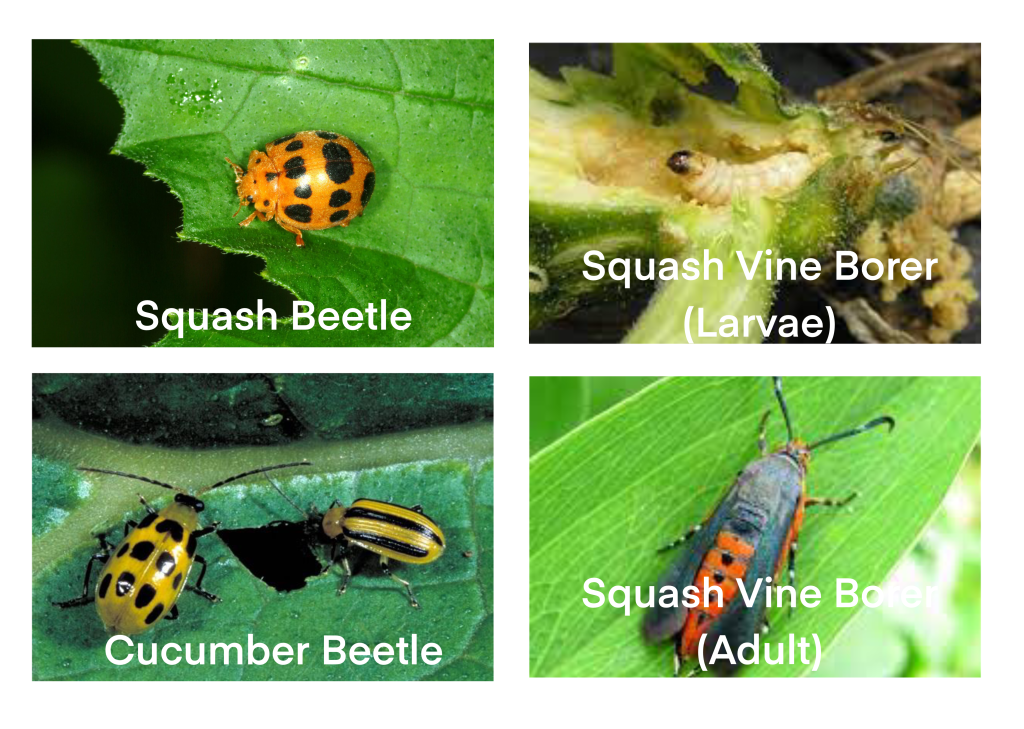
22 years doing this and I’m still not clear on pruning suckers from tomatoes. For me, more suckers is more flowers is more more fruit. I remove spent leaves, but leave the suckers. But you know, you do you if you have to prune the suckers. Be on the lookout for blights in solanacea. Proper crop rotation will be key to controlling blight (see previous entry).

Plant mint in a pot. Trust me on this one. Pots. Even if you want to be mint farmer. Even if you eat mint at every meal and drink mojitos for every drink. Pots.

Give basil lots of room to grow and plant of circulation to prevent fungus issues. True story; I had Covid-19 in early 2020 and Italian basil now smells like cat urine to me and doesn’t taste good. Which makes me sad because I make a great caprese salad with portobello mushrooms and asparagus. Thai basil is still fine for me. Weird.

Try a new herb in your garden this year. Herbs are great companions to so many plants and are super rewarding. Even if you don’t eat them. Fennel supports anise swallowtail butterflies and their adorable offspring. There are so many basil types and they smell so nice in the summer heat (I mean, as long as you didn’t get the OG covid virus). Lemon grass, lemon balm, and citronella all produce limonene which repels some insects when the leaves are bruised. Thyme can create a wonderfully fragrant groundcover. Mexican tarragon is an easy, no fuss herb that I will feature as my plant of the month in October.

Experiment and enjoy.

The Take-Away

Water is crucial and you should be monitoring it. I’m not a huge fan of most irrigation systems (another blog for another time) but something is better than nothing.

Give plants a little space for air to circulate. Watching for pests and fungus will be the big thing this time of year (aside from water).

Fertilize anything growing.

Deadhead perennials. It’s good for you and the plants.

Try herbs. They are also good for you.

Enjoy the warming weather. Enjoy your garden. Every time you connect with your garden, you are connecting to nature and a piece of yourself.

Garden Plant of the Month: Peonia

It’s shortly after Mother’s Day, 2022 and you can blame that on this entry.

Mother’s Day wasn’t a HUGE holiday in my family. Mom was a LDRP RN (I’m sure I’m missing some letters in there) and worked Sunday-Thursday starting at 7pm. So much of Mother’s Day she was asleep and when she was awake, she was getting ready for work. It was a weird schedule, but she loved what she did. She was one of 2 nurses in SC that specialized in high risk pregnancies and her expertise was well known in the state and region.

Despite the holiday not being a big deal, I often made sure that there was something sitting on the counter for her when she came downstairs before work. Sometimes they were just cards and some trinket. But I often went with what I knew and that was a plant from the local nursery.

My parents joked that I have two green thumbs, and neither one of them contributed that to me. And in truth, every time I gave her an iris, calla lily, stargazer, or rose, we all knew it was doomed. But those were her favorites and I always carried a spark of hope that THIS would be the plant that made it. Almost none of them made it, in fact. But one did.

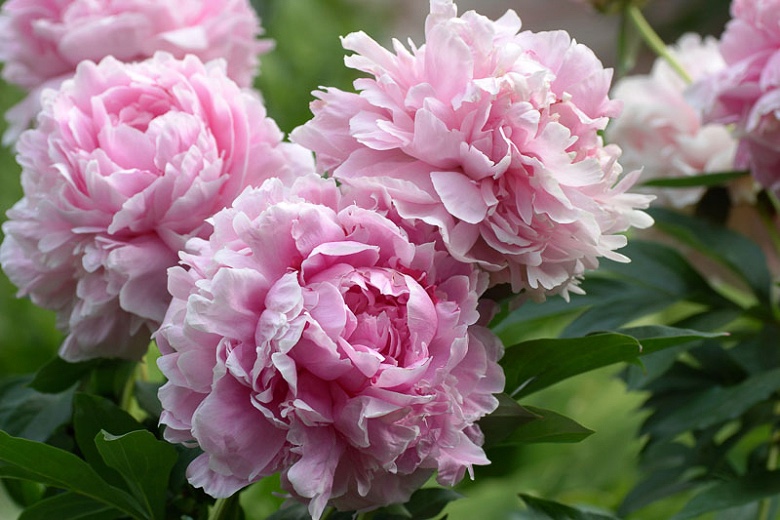
A peony. Peonia lactiflora ‘Festiva Maxima’ to be exact.

Ah, Festiva Maxima, for maximum festivity. A festivus for the rest of us.

It is well known among peony people that the south…well it isn’t for peony people. Our humidity and persistent heat do not match well with peony’s more delicate and temperate disposition. They love a warm day in bright clear sun, then they want to be cool at night so they can turn all that energy into starchy sugars to fuel their bright colored petals. When planted here, you may get 2 or 3 years before the plant just starts to send out a leaf or two. It will do that for a few more years and then they will diminish and go into the west and remain Galadriel.

But two peonies appear to laugh in the face of never ending heat and warm nights; ’Festiva Maxima’ and ’Sarah Bernhardt.’

‘Festiva Maxima’ is a stand out peony. It’s mostly pure white petals are peppered with magenta stripes that look almost painterly. It’s traditional peony fragrance is unmistakable, and I defy you to not think of some matronly figure in your past when you smell it. Most years my ‘Festiva Maxima’ has flowers the size of a salad plate (I felt snobby just writing that). Some years, when I’ve been neglectful and my peony wants to punish me, the flowers are the size of a large softball (Ha! Take that, middle school bullies. I know sports).

‘Sarah Bernhardt’ is a deep blush pink peony. The flowers I see in my client’s gardens are a little smaller than ‘Festiva Maxima’ but there do seem to be more of them. Fragrance is just as lovely as ‘Festiva Maxima’ but not quite as heady. The flowers tend to hold themselves up a little better. But I feel strongly both should be given some support; either peony cages or gladioli stakes (yes, I just lost all the earlier sport cred with that last statement).

Both varieties are considered early blooming, and that may be one of the reasons they do well here; they bloom before the exceptional summer heat starts. You can also help your peonies get the cold they need to set bud by being really stingy with your mulch in the winter, but generous in the summer. Planting shallow can help expose the roots to more cold.

On the topic of cold (and hot), place your peony where it gets good morning sun and afternoon shade. Since westerly sun is a good bit hotter than eastern, giving them protection will further efforts to keep them cool. I have heard tale of people also setting bags of ice on their peonies a few times a week in February to simulate that late winter chill that peonies love. I have not tried this myself, but it isn’t as kooky an idea as it sounds. The Augusta Golf Course does this same thing to prevent azaleas from blooming too early in the spring.

Because so much energy goes into creating these luscious blooms, apply a slow release fertilizer with a higher potassium (third number in the NPK ratio) in early spring, and a fertilizer with a higher phosphorus (the second number in the NPK ratio) after the plants finish blooming. Potassium helps boost flower production. Phosphorus helps build strong roots in flowering plants, which in turn gives stronger blooms and healthier foliage.

once the blooms fade, the plant sports attractive large coarse textured leaves that pair well will a lot of other sun loving perennials and shrubs. Prune the foliage off the plant when the foliage starts to look tired. I generally remove a leaf when over 50% looks brown and yellow. You should set peony foliage into a waste bag, as peony leaves do often carry and encourage botrytis fungus.

If you are considering peonies in your southern garden, I strongly encourage you to look into these two varieties. They are great performers and worth giving them a little space in your garden.

I’ll dedicate this entry to my mom, Pamela Sue (Miss Pammy, as she liked to be called). I hope everyone reading has had a mother figure in your life that allowed you to feel safe and loved. Mom, I love and miss you and hope you are surrounded by all the plants you killed, mostly from loving them to death.

Enemy Weed of the Month

When we first purchased our Ormewood Park home, I would describe the landscape as…lacking. The previous owners had stripped everything they deemed valuable to transplant in their new home just a few houses up from us, leaving only a few trees and shrubs that were most likely too large to economically move. We inherited a few holly shrubs, a large upright Japanese Maple, a curly willow, Hollywood Juniper, and some deciduous magnolias. Also a collapsed pool that had seen more activity from frogs and mosquitos than human swimmers in the past few years.

Around this time, not only did our new home have new residents, but Georgia did as well. At some point, a hitchhiker from another country found a welcoming home in the red Georgia clay. Maybe it was brought on purpose. Maybe someone found a stray seed clinging to their clothes and tossed it out of the window. Perhaps someone ordered a bag of seed to use as a grain substitute in an effort to reduce their carbs, dropped some on the floor and casually swept it outside. We don’t know how it got here, but Achyranthes japonica wants to make your garden its permanent home. I advise not allowing that to happen.

Achyranthes japonica, or Japanese Chaffe flower showed up the year after we purchased our home. I remember seeing it and being curious as to what it could be. Indeed, it had a very pleasant, I’m-meant-to-be-here look to it, with entire smooth edged and opposite leaves. I let them grow and as they got taller kept trying to figure out what it was.

I confess, it wasn’t until after it had seeded that I came to realize it wasn’t wanted, even before I knew what it was.

Chaffe flower LOOKS like something you want in your garden. It has all the hallmarks of something you may have purchased in a garden center. The leaves start off rather dark green, with strong venation and a pleasing undulation. It maintains a somewhat compact growth habit for a while before it reveals itself to be a weed with rangy and sprawling growth.

Looking all cute and stuff. I was trying to share this knowledge with a fellow hort friend the other day. I told him “wait, I’m sure I can find some in my garden.” After a few minutes of looking around we gave up. Of course, as soon as he left I found this small patch. It had the exact feeling of coming up with a great come back an hour after someone insults you.

A member of the Amaranth family, Japanese Chaffe Flower is named for the small seed heads that cling to clothes, fur, leg hair, and pretty m,ugh anything it can grab onto. After passing by a seeding plant in my super comfy loose fit sweats (I was wearing the sweats, not the seeding plant), it was a matter of just a few steps before the seeds that had grabbed hold of my pants began to grab the fabric as it moved, adhering the folds together until my pant legs were just a matted clump of fabric clinging to my leg.

When the seeds first germinate (seeds are extremely viable, meaning most seeds will germinate), the leaves are slightly oval with a rounded point. The margins are entire, meaning smooth with no cremate, serrate, or dentate edging. To me they almost always look like they are struggling, like a bug or fungus is affected them. They look very similar to other amaranth seedlings like celosia or spinach. Indeed, this plant is edible and medicinal. But I don’t believe these virtues make up for the invasive tenacity this plant possesses. It can push through the thickest of ground covers and will out compete some of the toughest perennials and small shrubs.

Seedlings emerging near the parent plant above

Unlike many Amaranth, the leaves remain opposite.

You can see here how the leaves are opposite one another along the stem.

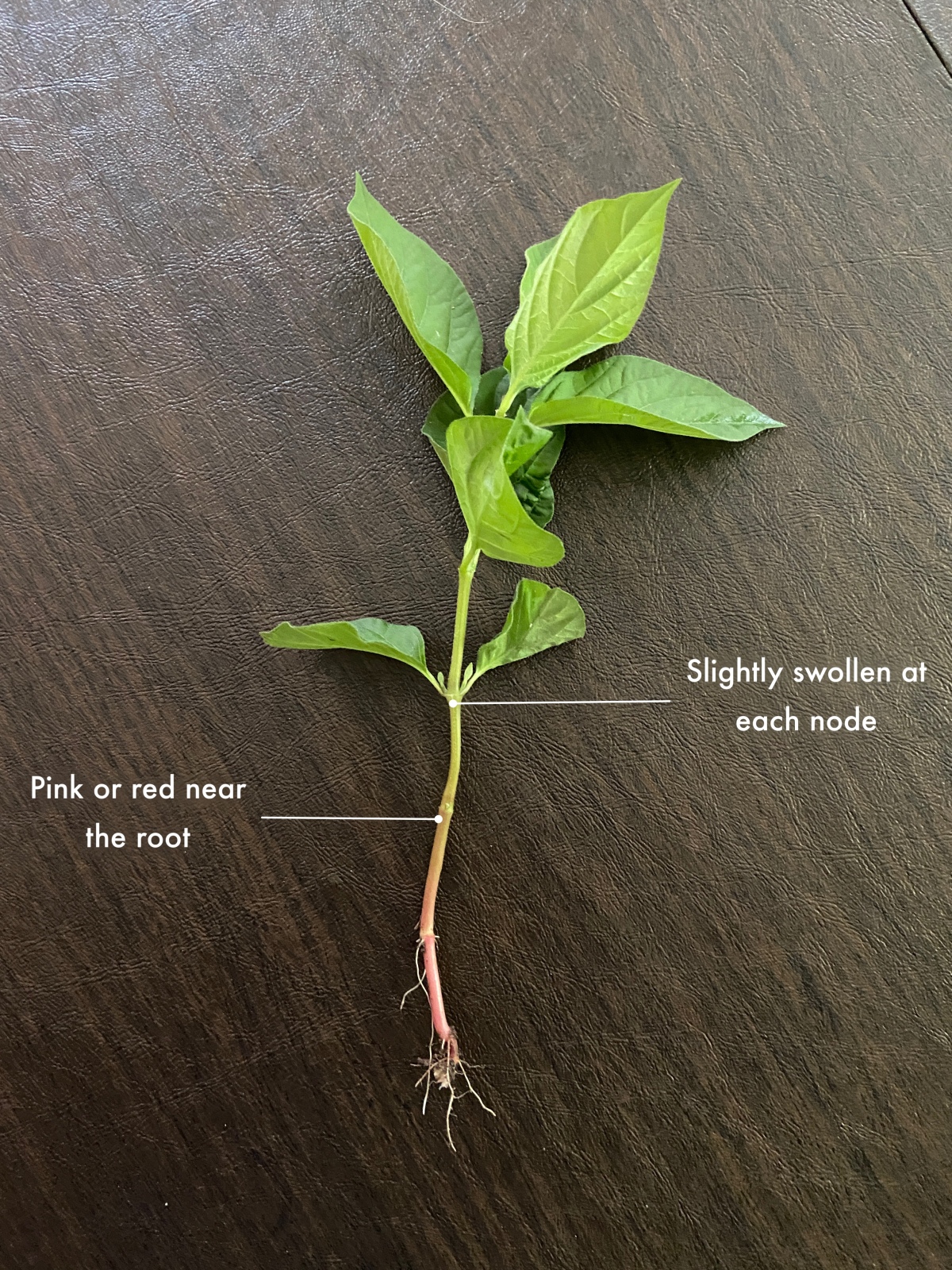
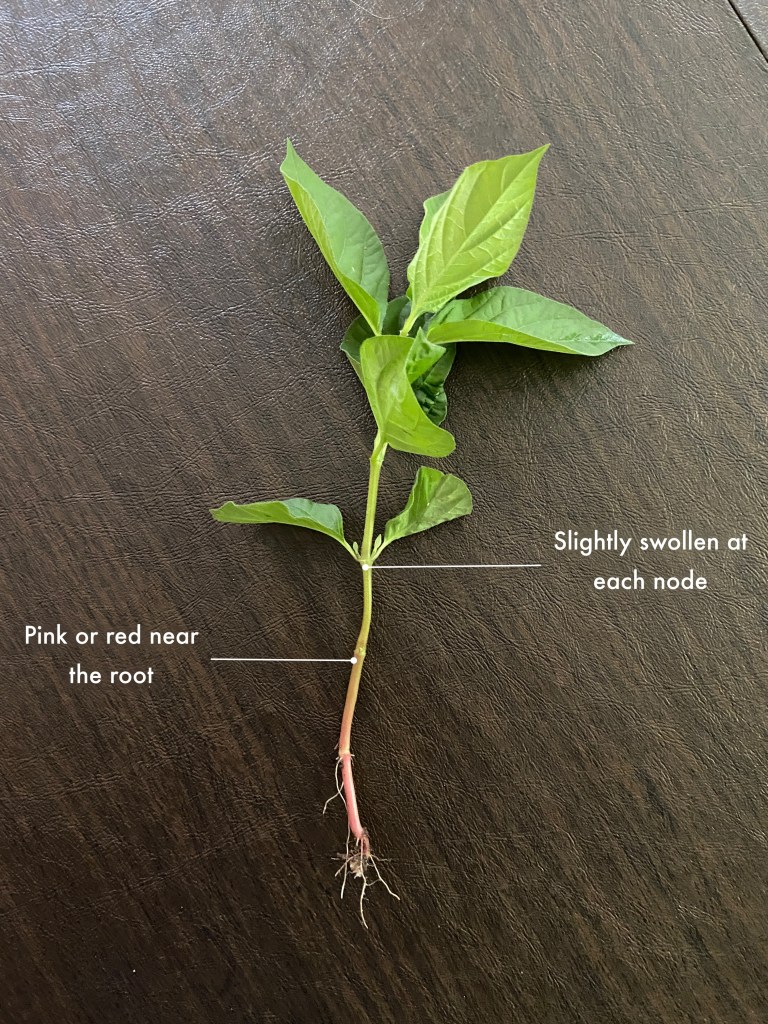
The stem near the top of the plant has a square feeling, accentuated by small ribs running up the length of the stem. At each node, where the leaves join the stem, the stem is slightly swollen. The stem gradually becomes a pinkish color near the base.

Roots are often fleshy and thick. This specimen shows more root hairs as the thicker stems refused to come up, breaking at one of the submerged nodes. I suggest using a hand trowel or knife to assist in getting the roots.

Then destroy it with fire. Ok, that’s hyperbolic. But definitely do not compost this weed, or it will mock you. Bag it securely and pray it never finds its way back to you. That isn’t hyperbolic.

The infamous seed-heads, ready to grab a hold of you and follow you to the ends of the earth.

May to do… aka Mulch Ado About Something

It was always too early on one of the first weekends of Summer Break that my mom would joyously bust through the door with a song on her lips (some made up hymn celebrating the many virtues of either physical work, rising early, or the unrivaled joy of doing some forced voluntary task for your mother) to ease my brother and me into the reality that we would be spending the day spreading mulch that would be arriving any moment from a random landscape supply company.

And before you ask, yes, I did lock my door. It wasn’t until I was 17, however, that I discovered the closet doors actually lacked that little hole in the knob, thus thwarting an over zealous mother from sticking a straightened wire hanger into them to unlock, and subsequently harass me whenever she deemed necessary. Which for the record was all the time. Before I switched the door knobs, she basically carried around a wee bit of hanger she had fastened into a skeleton key for all the doors in the house. After I switched the knob, she began to use the door as a drum to keep time for her insane, inane, and irritating ditties. The moral here; don’t try to win against a manic mother. It isn’t possible.

After her triumph was clear, I’d drag myself downstairs and outside where some guy in a truck had left a steaming pile of shredded mulch. Mom would perch herself on the front steps, coffee in one hand, a trowel in the other, a fully formed delusion that she would be working along side us, and begin bossing…I’m sorry…DELIGATING. My brother and I would then spend most of the day moving mulch into the yard beds until she was satisfied. Then she would stand up, brush off her butt and say something like “wasn’t that fun? Who wants pizza?”

Most mothers don’t like to hear objections. Mine was no different. But more than objections, my mom hated to hear that she was wrong about anything. But I can tell you with utmost certainty that she was wrong to make us mulch in June. She should have had us do it in May. May is for mulching. And many other things. So let’s get started.

General Tasks

I may have not made it clear, but you should be mulching. And weeding. Weed first, then mulch. Mulching suppresses weeds, keeps roots cool and moist, maintains soil health, and (this is an increasingly helpful thing) prevents rain compaction. Rain compaction is the phenomenon where bare soil becomes increasingly hard and compacted because of the pressure of rain hitting it over and over again. So yeah…mulch. It’s good for you and your garden.

Let’s talk about mulch, actually.

There’s been a proliferation of homes in my area using dyed mulch. I won’t go into my design snobbiness about these. Not everyone’s aesthetic is the same. I appreciate that. However, when it comes to soil health, I’m downright judgmental, and I’ll explain.

Mulch is harvested in a variety of ways, most of which are by products of lumber milling. A tree is cut, sent to a mill, and made into building material. The off pieces, small branches, and disfigured pieces are stripped, shredded, and made into mulch. Except dyed mulches.

Dyed mulches come from lumber that has outlived it’s usefulness. Warped fence posts, scrap building lumber, and worn out pallets and run through an industrial chipper, screened for nails, and then dyed. The dyes aren’t generally great for soil, but the chemical treatments of the pallets and building lumber are down right toxic. Arsenic, copper, and other chemicals are infused into the wood to prevent decay by insects and fungus. Insects and fungus are actually imperative to healthy soil. Without them, soil becomes sterile, compact, and depleted. Without fungus, the ability of plants to take up nutrients and even water drops dramatically.

I advise using natural mulches, like pine bark, pine fines, oak, and such. I also advise against cypress as it is a slow growing wood and the harvesting of cypress isn’t very sustainable. There is also little evidence that it deters insects like many a nursery espouse.

A great way of making your mulch last longer is to lay your new mulch on top of the old. The microbes in your soil should be continuously breaking down the organic matter on the surface of the soil. Placing new mulch on top of the old keeps these microbes breaking down the old mulch before they start on the new mulch. You can also shred your fall leaves and use this as a layer of mulch as well. I love doing this in the fall. After a few rainfalls, the leaves get stitched together by decomposing lignins and mycorrhiza to form a paper like sheet of protection from both weeds and cold.

Perennials and Annuals

If you haven’t already setup peony cages, do so now. Peony cages are wire grids that allow peonies and other floppy flowering perennials to grow through them and offer extra support for the flowers, many of which have been selectively bred (not genetically engineered) to have large showy flowers, sometimes beyond the ability of the plants to support them. Even plants that can support their flowers can benefit from a cage or a stake when we get our torrential rains in the Spring and Summer.

Cutting back many aster and chrysanthemum perennials now will give you a bigger show in the fall. At each cut site, two or more stems will form. Allow these to grow and then cut those as well in June/July. What we are doing here is creating more auxiliary buds, which create the tissue that will become a flower in the fall. More auxiliary buds means more flowers. More flowers means a better sense of accomplishment, right?

In your annual beds and mixed borders, it is time to sow your warm season flowering annuals. Good choices for our area are zinnias, cosmos, celosia, cleome, morning glory (if you must), nasturtium, coleus, marigold, and sunflowers. There are several annuals that do grow now, but should have been started in fall, such as foxglove, delphinium, and poppies (basically my favorites. I also do better in fall than late spring. So maybe that is why).

Trees

If you planted a new tree within the last two years, continue to monitor rain fall. We want to aim for about 1-2 inches of rain a week while trees are growing. This gives them what they need to create healthy leaves for catching sun and converting it to food. If it is dry, irrigate so your trees grow healthy and strong (and capture the excess carbon in the air).

Trees like persimmons, gingko, crepe myrtle, figs, and a few others may try to sucker right now. Suckering is when a tree sends off a shoot from the base to become a new tree. Go ahead and clip these off. First, a tree that is allowed to sucker will often perform poorly, diverting resources to the sucker, making the tree more of a large bush. Second, some trees are grafted (meaning the top is a more productive or valuable species, and the root is a hardier species, giving us the best of both worlds) and allowing the sucker to grow will actually overtake the upper grafted species. Roses will also do this. Which reminds me…

Roses

During this busy time, I definitely need to remind myself to stop and smell the roses. And then get to fertilizing them.

Roses are needy. Much like natural selection leads plants to create outlandish displays to attract their favorite pollinator/propagator (watch any documentary on orchids), roses appeal to their favorite pollinator through color, scent, and design. It’s us, btw. We are their favorite pollinator. And in the journey to create more elaborate, perfumey, and interesting plants, we created a spoiled brat that will pitch a fit if we neglect them. So here is how we care for our attention seeking roses.

Feed them. While roses are blooming, they need a lot of fertilizer. For simplicity’s sake, I recommend Espoma’s Rose tone. It is well balanced and won’t burn your roses, nor lead to weird nutrient build up like a synthetic 10-10-10. Feeding them will also help their already compromised immune systems (that’s right. Plants have immune systems).

Give them space. Crowding them with other roses or plants in our humid environment will lead to black spot and other blights. Not to mention easy access for pests. Give roses a lot of elbow room for air circulation.

Watch for rose rosette disease. This viral infection was once considered a godsend as it seemed to favor Rosa multiflora, an introduced species that got way out of control and tried to take over the south. Which really irritated the kudzu and it was an all out war. It was basically Godzilla vs King Kong but in slower motion. Until rosette disease turned the tide. Which was cool for a minute. Then the virus decided it wanted more and now it is attacking the codependent pleaser of the rose world, Knock-Out Roses. The virus extensibly turns the new growth into a twisted, red, scraggly mess, and prevents the flower buds from fully forming. Flowers that do form burn immediately in the sun. If you see this growth, follow the stem down to the main stem and remove the entire branch. Then rub your pruners with alcohol so you don’t transfer the virus to other roses.

Lawns

Finish sodding this month if possible. June can sometimes be mild and agreeable for new sod, but I wouldn’t bank on that.

Fertilize regularly during the growing season. Mow only when the grass is dry to prevent many fungus and mold issues. If you do have fungus in your lawn, treat as soon as you see it. If using a mowing service, make sure they are sterilizing their blades between clients so issues are transferred to your yard.

Mowing heights are pretty important. Proper height keeps grass more resilient and disease free. Some common grasses in our region mow heights are:

Height for Warm-Season Grasses

  • Bermuda: 0.5 to 2.5 inches
  • Centipede: 1 to 2.5 inches
  • St. Augustine: 1 to 3 inches
  • Zoysia: 0.5 to 3 inches

Best Height for Cool-Season Grasses

  • Fine fescue: 1.5 to 4 inches
  • Kentucky bluegrass: 0.75 to 3.5 inches
  • Perennial ryegrass: 0.75 to 2.5 inches
  • Tall fescue: 1.5 to 4 inches

Veggies

Veggie season is well underway. Your cool season plants should be nearing the end of their time, so harvest and replace with warm season.

Do not neglect the fertilizer here. The energy it takes for your fruiting veggies (any “vegetable” that is a result of a fertilized flower, and thus the ripening ovum) is great, and just compost isn’t going to cut it. Compost is different from fertilizer. You need both for a truly productive garden.

Watch solanacea and basils for blights. If you see a leaf that looks suspicious, take a pic and look it up. It only takes a few days for many blights to spread. A great way to keep your disease issues in check with veggies is to practice crop rotation. Without getting too complicate, don’t plant the same annuals in the same beds year after year. It works best to go 3 or more years before planting the same annual in a bed. Look! I made you an animation!

Animation is clearly not my strength

The Take Away

Weed! Weed as if your life depends on it because the life of your plants does. M

Mulch! Because it will keep the weeds suppressed and make your soil healthier and your garden look cleaner.

Fertilize for success.

Enjoy the emotional and literal fruits of your labor.

Every time you connect with your garden, you are connecting to nature and a piece of yourself.

April To Do…aka Only Fools Rush In

One of my favorite times to be a horticulturist and gardener in Atlanta is in April. We get to sit back, relax, watch the ferns unfurl and the flowers bloom. I love to grab a cocktail in the late daylight saving afternoon and sit still while the bees hurriedly buzz about, frantically harvesting the first drops of nectar and pollen. Good news, everyone! There is nothing to do in April. Absolutely nothing.

And if you believed that, APRIL FOOLS! Because there is so very much to do in April. We are rapidly approaching the last frost date and as of this writing (April 1, 2022) it appears the arctic vortices are Netflix and chilling for the spring season.

Let’s get started because even though we are right on time, we are already late. (Nature is sorta like that toxic workplace boss with the mantra “If you are early, you’re on time. If you are on time, you’re late.” Because nothing creates quite the sense of terror than establishing that your scheduled time, in print, by your boss is a lie. But it’s all good because “we are like family, here.”)

Perennials and Annuals

With the threat of frost in most metro Atlanta and North Georgia areas over, it’s time to sow seeds that either have to be planted in situ (fancy way of saying “where you want them to grow”) or that you forgot to start early inside. Note that anything that needs frost/cold stratification (fancy way of saying “needs frost to break the seed coat”) will have to be manually stratified (fancy way of saying “scuffed up with sand paper or something”) or artificially cold stratified (fancy way of saying “put in moist sand or paper towel and placed in fridge or freezer”). Consult your seed packet for this kind of information. Also, I wrote that entire paragraph in a British accent to really impress how fancy those terms are.

Roses should already be pruned down. If you forgot, drop everything and go do them now. Even if you have to call in to work to do it. Do it. I’ll attach a fake doctor’s note for you.

Print and laugh, cuz this isn’t real.

Deadhead any flowering bulbs that are finished flowering. You may divide and transplant sizable colonies of flowering bulbs now to spread the love. Except tulips. Don’t waste time on doing anything with your tulips as we are not tulip country (believe it or not, tulip country is natively Persia, and tulip is the anglicized word for turban), and treat them as annuals. Summer bulbs can be planted now.

If any of your perennials are still largely dormant or just breaking dormancy, you may still divide them. If they are more than 5 inches leave them be and make note to divide them in fall (except phlox and iris).

It isn’t too late to apply pest and fungus sprays. Follow the directions on your preferred product.

Shrubs and Trees

You should be fertilizing now. Like NOW now. For trees, apply fertilizer no less than 2 inches away from the trunk, but concentrate most of your fertilizer near the drip line, which is just outside the edge of the tree canopy. This is where most of the root hairs exist, which is where most of the water and nutrient absorption takes place. For shrubs, broadcasting a good organic fertilizer will be fine. If using synthetic, follow the instructions on the product package. I generally don’t advise using 10-10-10 fertilizer every year, as phosphorus and potassium have a tendency to sit in the soil and can build up. If these macro nutrients get too high, they can cause nutrient lock with some of the micro nutrients.

Veggies and Herbs

Fertilize the last of the winter veggies. It’s possible to still get a few root veggies going, but I would stick with carrots and beets. If it starts to get too warm, you can still eat the greens. Beans and curcurbits (cukes, melons, squash) can be planted by seed now. Or you can get a ton of great selections from the Wylde Center or Love is Love Farm plant sales. Tomatoes and peppers can be started from seed, but they require soil temps to be in the 70’s. You can heat your soil by surrounding your plantings with black weed fabric, plastic, or stones. Or you can do what I do and just let the experts start them for you and buy them directly (see suggestions above).

Lawns

TL;DR: Start setting your mowers higher. You can sow cool-season grasses yesterday. The later it gets the less successfully it will germinate. Warm season grasses are good to go. Sodding is in full swing. Fertilize lawns near the end of April. Top dress with screened compost or composted manure (never fresh).

Editorial silliness now:

I’m going to be honest with you all…lawn turfs are not my speciality. I’m one of those people who can learn and retain a great deal of information on anything I’m marginally interested in. And turf grass has never been one of those things. In school, I’m pretty certain the only reason I passed Turf Grass Management was because I suffered a major family loss and the professor felt sorry for me.

Don’t get me wrong, I know people LOVE their lawns. Especially men. Even more especially straight men. I have a neighbor (whom I adore) who will become completely blind to the rest of his garden as long as his grass is a beautiful lush green. I swear, I saw him once crouching with a ruler making sure it didn’t get too tall.

And I do often advocate for at least one small area of turf. It gives the eye a clean, unchallenging place to rest before taking in the rest of the garden. And gives dogs a great place to poop (except the aforementioned neighbor’s grass. He will go banana cakes if he sees a dog pooping on his lawn).

But grass isn’t my passion. And it shows in my own garden where my itty patch of turf is a good ol’ southern lawn; riddled with clover, violets, and the last vestiges of maybe fescue the previous owner planted.

Another TL;DR: I’ll continue to place lawn tasks in my To Do posts, but they will be very institutional. Though I am proficient in turf grass management (I did actually get an A), it just isn’t a subject I can speak to for hours. If you are having lawn issues, turn to companies that specialize in turf grass. I am not the gardener you are looking for (waves hand Obi Wan Kenobi style).

The Take Away

There is a lot to do this month to make life easier and your garden more enjoyable in the months to come. As always, enjoy your garden. Every time you connect with your garden, you are connecting to nature and a piece of yourself.

March to do…aka Planting Too Early

It’s the most wonderful time of the year! As is often the case, we step into March in a flurry of pollen, which many Georgians call “The Pollening,” which follows “Third Winter.”

So let’s load up on our antihistamines, refill our neti pots, and jump right into what to do this month in the garden. (If you’re a TL;DR person and you have already purchased your summer veggies from the closest Big Box Store, skip down to PLANTING.)

Shear those (broadleaf) hedges! Boxwoods, hollies, distylium, and other broadleafed evergreens are ready to be sheared and shaped. Any broadleaf evergreen that isn’t scheduled to bloom in the spring or early summer can be pruned. Fathers around the city can gleefully exert their will on another living thing in what might be the suppressed need to control something in their environment without it talking back at them.

If your conifers are growing, you may prune them now as well, but ONLY if they have new growth.

Continue to spray sulphur on plants that have had insect issues in the previous years.

Trees, shrubs, perennials, and lawns will all benefit from a top dressing of screened compost.

Lawns can be dethatched and aerated as well. If you spread winter rye, you may mow it to 1” now.

Mulching should be on your agenda soon. If you don’t normally mulch, consider starting this as a habit. Not only does mulch save you time and energy on weeding, it also improves soil quality. Many of my more particular clients prefer we remove last year’s mulch and replace. For those of us who are interested in sustainability and being economical (I was trying to figure out a way to combine economical and ecological into one word, but just couldn’t do it) lay your new mulch on top of the old. Not only is it less work, it also preserves your new mulch for a longer period of time.

PLANTING

I’ve seen a few posts on NextDoor and received messages from neighbors and clients itching to plant.

Cool season plants like lettuce, kale, carrots, beets, and others can still be planted. Dormant perennials and hearty trees and shrubs can also be planted. But almost everyone really wants to know about their tender herbaceous plants; tomatoes, basil, peppers and the like.

Short answer: it is too early to plant. Our last frost date is April 15th. This isn’t our average or mean average last frost date. This is the actual last frost date. We haven’t had frost after tax day. In my 23 years here in Atlanta, we have had many frosts on the 15th.

Long answer: Planting tender herbaceous plants before the last frost date doesn’t behoove you or the plants. As we approach the equinox, the soil temperatures are actually cooling where the air temperatures are warming. Tender herbaceous plants, like many herbs, and certainly any non native solanacea (tomatoes, peppers, eggplant, tomatillo, etc) are understandably going to be unhappy with cool air temperatures, but they are going to be downright petulant if the soil temperature is cold.

Petulant tomatoes! What does that even look like? A tomato that has been planted in cold soil will actually refuse to grow for a while. The cold soil will prevent root hairs from growing, and if root hairs aren’t growing, their dying. Root hairs are the drama kid of the plant anatomy. They are either exuberant, pushing madly through the soil, or languishing with their root hair hands across their brows, crying “I literally can’t even!” And then they die. So when soil temperatures and air temp are perfect, the tomato has to grow new root hairs. And they will prioritize root growth over vegetative or (more importantly) flower/fruit growth.

I can hear you thinking “Ok, Joshua. If it’s the wrong time to plant these things, why do the Big Box Stores sell them, huh? They wouldn’t steer me wrong. They want me to succeed. What do you have to say to that, Mr. Smartypants horticulturist?”

Profit. That’s what I have to say.

We run out, buy our favorite ‘maters, then pop them in the ground the first weekend of March and say “Stupid horticulturist. He doesn’t know anything.” And then we get freezing temps the second weekend of March and have to buy those plants all over again. And the CEO’s laugh. No, it’s true. They laugh. They laugh at those who bought the tomatoes twice (or three to four times if you’re really stubborn), and they laugh at the horticulturists who are basically Cassandras warning everyone that the big wooden horse is full of frost.
And then you know what they do? They stop selling tomatoes around the middle of May and start trying to convince you to buy Halloween or (even worse) Winter Holiday décor. In May. Pools haven’t even opened yet and they are trying to convince us to snap up inflatable Santas and wicker deer. Meanwhile, you want a nice fried green tomato sammie, but all you have is a rosemary shrub trimmed up like a Christmas tree, bedecked in red ribbons. This is creating a false demand for tomatoes in February/March.

I digress.

I’m not saying don’t buy those tender herbaceous plants. In fact, do. Quickly. I went all year last year without Thai basil because I waited too long, and my home made pho mocked my choices with every spoonful. Buy them, but don’t plant them unless you can protect them. If you have already planted them, find something to cover them with when frost is in the forecast. You can even set a few dark stones around them to help harvest radiant heat. If you have them but haven’t planted them, set them outside during the day but pull them in on cold nights.

You can also set them in a garage. If you have a cold frame, be vigilant about popping it open during the day. I once forgot to tell my husband to open the cold frame while I was at a conference and came home to 8 trays of steamed vegetable and ornamental plants. Sad and smelly.

Lastly, don’t forget to enjoy your garden. Every time you connect with your garden, you’re connecting to a part of yourself and nature.

The Garden Alchemist

Where Alchemy is the transformation of matter from one state to another, Alchemy Gardens and Design transforms outdoor spaces into gardens that reflect those who call it home.

My name is Joshua Tabor and I’m happy to introduce the blog for Alchemy Gardens and Design. Based in Atlanta Ga, I have been involved in horticulture and garden design for over 20 years. If it involves plants, I’ve probably had some experience; from medical herbalism and hydroponics, to nursery production and personal gardening. I’ve worked with residential homeowners, public municipalities, non profits, and horticulture service companies to create unique green spaces that reflect my passion for nature and design. My design and horticulture work has been featured in various publications and found throughout the metro Atlanta area and beyond. Be it a native meditation garden in the Serenbe community, food forests in public Dekalb county spaces, or a xeriscaped oasis in Palm Springs, every challenge fuels my desire to connect people to their gardens, to nature, and maybe to a part of themselves.

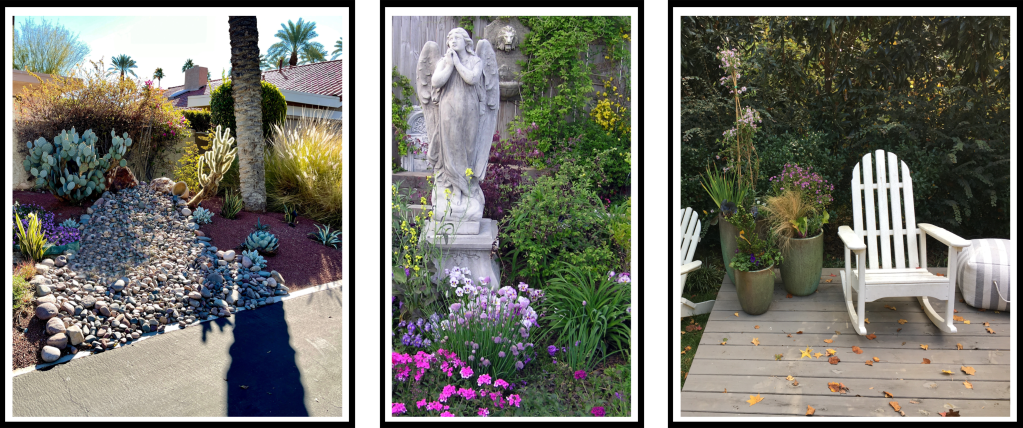
Various projects, including a residential garden in Palm Springs Ca, a display garden for an upscale nursery, and residential garden in Atlanta, Ga.

Check out my homepage for more information about the services my company offers and a portfolio of the work that I have done for clients in the past.

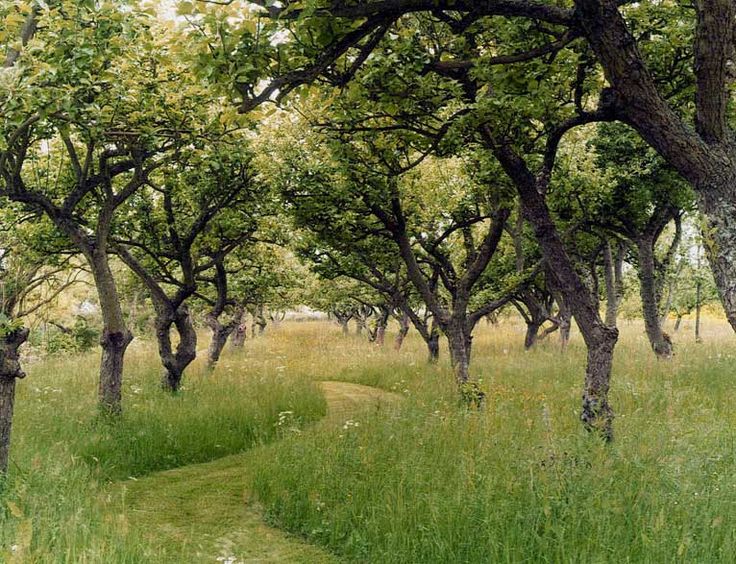
meadow orchard with a path in the grass
Reclaimed meadow in an established orchard

If you have questions about how Alchemy Gardens and Design can help you transform your outdoor spaces into an inviting part of your home, please visit the Contact Us page.