August to do…aka The Dog Days are (almost) Over

It’s a bad sign when I can recite my credit card number, expiration date, and security code without looking at it. Numbers, unlike words, have often made very little impressions in my head. To this day, I have to run through my entire social security and phone numbers to get to the last four digits. But as I order yet another weird garden plant I ABSOLUTELY do not need, I can type with the utmost confidence my credit card number in its entirety.

And this trend probably won’t abate anytime soon. Because it’s August. And August means so much hot, so much humid, and so much of me complaining and wondering why I got into this occupation.

But then my plants will arrive in September and October and I’ll remember that my connection to plants is (don’t laugh) spiritual and intuitive.

For the record, I have ordered a new rose, a thornless blackberry, a ground orchid, and a Dryopteris I’ve wanted for years and just finally bit my lip and hit “order.” I’ll let you know how they turn out.

So August. If you’re in the south east for any length of time, you know it’s hot and humid now. But the end of August is sort of like May in that it can be unpredictable and weird. The experienced gardener knows this and can be flexible.

General Notes

August is hot and humid so be on the look out for fungal issues. The most prevalent will be powdery mildew. The good news is that powdery mildew is pretty host specific, affecting specific genuses and species rather than the whole garden. Plants like Monarda, sages, species rudbeckia and echinacea can have a lot of powdery mildew and still be healthy. Cut infect plants back and discard the debris in a compost pile or bag. Don’t leave debris lying on the ground as the spores will continue to spread.

Mulch thin areas.

Weeding should be slowing down if you have been vigilant. If you’ve been lax (no judgement, because glass houses and all that), get out early in the day and pull a few weeds while you drink your coffee. It’s better than nothing.

Circulation is still very important, even if you have a cottage style garden. Make sure plants have adequate airflow around them.

Perennials

Deadhead plants you do not wish to go to seed or attract birds with. I leave my rudbeckia and echinacea heads on at the end of the month because goldfinches are some of my favorite birds.
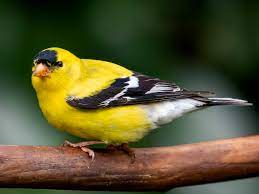
I mean, seriously. Look at this cute little fella.

It’s a weird time, but iris likes to be divided now. Simply lift out of the soil and divide new rhizomes from old ones and replant. Old iris rhizomes won’t rebloom so they can be discarded.

You may (finally) give asters and mums one final haircut before they start setting buds at the end of the month.

Fertilize blooming perennials with a nice organic fertilizer.

Shrubs

Stop trimming evergreens except random shoots. Cut these down below the general shape. Any shaping should be done with regular pruners, not shears.

If you do the whole gibberillin thing with camellias, now is the time. If you don’t know what that is and don’t plan on being a camellia society person, don’t worry about it. If you do want to be a camellia society person, look up gibberellic acid on camellias and see if it is something you want to do. It’s an interesting hobby.

Roses

Continue to feed anything blooming. Mulch is still needed.

You may see random shoots that look slightly different than the roses that were blooming earlier. Follow these down to the base of the rose and you’ll most likely find they are shooting from below the graft union. The graft is where the grower attached the desired rose to a hardier root stock (we’ll get into this later when it is grafting season). If the root is sending out scions, they can easily over run the grafted rose, so remove them at the base.

Keep a watchful eye for rosette disease. This is rampant among “Knock-Out” varieties. If you see weird growth, cut the whole branch out and sterilize your pruners with every cut.

Rosette Disease. Weird and unsightly.

Trees

Keep em watered cuz they are providing share. I don’t believe in panaceas but trees really are. They make everything better, so give them at least 1” of water a week.

Lawns

Mow no less than 3” from root. Watch for fungal diseases.

Veggies and Herbs

It’s that weird time where some warm season veggies are just about to give up. Tomatoes especially. As plants start to succumb to the humidity, remove them and trash. Don’t compost solanacea in working compost piles as they can introduce tomato blights to your finished product. If you have a lazy compost pile (ie you’re just keeping food wastes out of landfills) you may throw them in there.

Make note of where you planted things if you haven’t already so you can practice crop rotation. Do not plant the same plants in the same place year after year. If you had blight in any of your beds, you’ll want to keep those species out of that spot for about 2 warm seasons.

You may sow bush beans, cucumbers, and bush squash for a late season harvest.

Keep harvesting. It seems counterintuitive but harvesting your herbs and veggies keeps the plants healthier and more productive.

The last week of August you may start planting cool season veggies.

If you don’t want to sow your own but are interested in cool season crops for your garden, please contact me no later than 8/19 for a list of cool season crops my friends can provide.

The Take Away

So much rain and humidity helps fungus thrive. Be watchful.

Water if we get less than 1” of rain in the week. We are getting lots of pop-up showers all over the south east, but they might only be a fraction of an inch at a time.

Harvest everything.

Prune with discretion.

Even with this muggy weather, wipe your brow and connect with your garden. Every time you connect with your garden you are connecting to nature and to a piece of yourself.

I need a Window Seat, because this Flower is Wiltin’

A summer vignette

If you’re existing anywhere in the northern hemisphere right now, you’re probably hot and sweaty. And here in Atlanta is no different (and the heat is no joke). So we’ve been calling it quits early in the day in order to remaining semi functional and healthy.

Which has given me a little time to actually come back to the less gardeny part of having a garden business; media management. Which I’m sure anyone with eyes can tell is my least favorite part of anything.

But the heat itself is a pretty good subject to talk about in regards to our gardens.

Here in Atlanta, we’ve had a hot and wet summer. It’s a far cry from the decades long drought conditions we’ve had in the past (oh ho! But don’t be fooled…we will have drought conditions again, mark my words). Many of our new clients are looking for water mitigation solutions before we even discuss how they would like to use their existing garden spaces. And all that water has been great for the garden plants…to a point.

Unfortunately, the wetness and heat can lead to some fungal issues. Especially in heavily planted areas. Fungal issues can present in a number of ways.

Leaf spot diseases are some of the most common funguses. Easy to identify on roses and close relatives (black spot), maples, hydrangeas, and fruit trees are all susceptible to different fungi that cause discolored spots on the leaves.

Rusts and powdery fungus are also fairly common. Leaves look dull or fuzzy, sometimes with bright orange or red growth on the leaves, while the leaves themselves start to contort and wilt.

When these fungi appear it is often a good indication that there is a lack of air circulation (it often indicates too much water, but there’s only so much we can do when the rain gods are feeling generous). Improving circulation is going to be one of the most helpful things you can do. It can also be a challenge for those of us super attached to our plants as some editing is often needed. Make sure plants of the same species are planted so that they can touch, but aren’t growing too much into one another. Give groupings of plants in different species a little elbow room. I like to imagine enough space for a cat to slink through without touching the plants. Cut away diseased parts of the plants and dispose of (don’t compost) the trimmings.

Another way to prevent fungal issues is to prune open super compact plants. Hollies, boxwoods, herbal shrubs, camellias, etc…these plants are often pruned to create dense shapes. Though they look great, the dense foliage can create nice humid little nurseries for fungus (and insect pests). Don’t fret, though! Opening the plant up doesn’t mean getting rid of its shape or function. I like to reach into an area and grab a branch and gently move it. It it moves only a small section to create a gentle opening, I remove it at 1/3 of the way into the plant. A half a dozen cuts like this will often provide the proper amount of circulation to keep fungus at bay.

If fungus is already out of control, copper fungicide is a great treatment (use as directed). I find it works a bit more reliably than neem as a fungus treatment. I do still highly recommend the above steps as well.

We’ve been spending more time out in our garden at night.

Now, don’t misunderstand me and think that all this heat brings some fun guy to wreak havoc on your garden. No no! There’s more. And I’ll be discussing them this week so we can get all of our gardens back on track to be the beautiful oasis we need them to be.

Until then, stay cool. And contact us if you need advice on any garden service.

March to do…aka Shall the Circle Be Unbroken

And so it begins again. Where we started last year to where we are now, it’s hard to imagine it’s been an entire year.

I started this blog to get my experience as a horticulturist in Georgia and my knowledge I’ve gathered out of my head and into the hands of people who need the information. I’ve also used it to show people that gardening is a science and an art and it’s good to have someone on your side who understands that balance.

Though I had hoped that some readers would reach out to hire either myself or my company, I didn’t expect so many to be interested in what we do. I’m truly humbled by the amount of readers who have entrusted the care and vision of their garden to myself and my talented crew.

As we march through this next year together (get it? March?), let’s take a look at what needs to be done now. (If you forgot what happened last year and have already purchased some new, shiny plants from Lowe’s or HD, skip ahead to PLANTING.)

General Info

Oh, March comes in like a lion that’s done some speed, taken up the drums, then given up that hobby to take a nap…all while throwing mad amounts of pollen about to really mess with our allergies.

But the fact remains, the sun is in the sky longer, the soil is warming, and we have Daylight Saving Time to contend with.

Let the tulips and hyacinths you planted last winter invigorate your desire to garden.

Topdress with compost on lawns and flower beds.

Fertilizer applied now will be available to newly budding plants.

Mulching should be on your agenda soon. If you don’t normally mulch, consider starting this as a habit. Not only does mulch save you time and energy on weeding, it also improves soil quality. Many of my more particular clients prefer we remove last year’s mulch and replace. For those of us who are interested in sustainability and being economical (I was trying to figure out a way to combine economical and ecological into one word, but just couldn’t do it) lay your new mulch on top of the old. Not only is it less work, it also preserves your new mulch for a longer period of time.

It’s a little tricky to figure out what didn’t make it through theearly winter cold snap. Be patient. Some plants are a little shy after that sort of experience and may wait until April to break dormancy.

Shrubs (and Trees)

Broadleaf hedges are starting to grow(but not the conifers)! Get out there and shear them like sheep! This is the only time of year I condone shearing broadleaf evergreens, as long as they are not blooming, or soon to bloom in the next few months. Leave azaleas, gardenias, and such to right after they bloom. That’s right, I’m giving all those over eager fathers with twitchy power tool trigger fingers permission to really go for it. Get creative. Tap into your inner Edward and try topiaries or odd shapes.

If your conifers are growing, you may prune them now as well, but ONLY if they have new growth.

Continue to spray sulphur on plants that have had insect issues in the previous years. It smells a little bit, but the odor dissipates pretty fast.

Speaking of things that smell bad, if you have caught a whiff of something that reminds you of your early 20’s and regrettable choices, that would be Bradford Pears blooming. These once favorite child of contractors have really taken over Georgia and much of the south as we learned in horror they are not sterile (as we were led to believe). Their stinky children have been carried all over the dirty south and caused a lot of headaches. If you see them on your property, it’s a great time to consider replacing them.

Perennials

You can still continue to divide and separate perennials, except phlox and iris (wait till they finish blooming). If you are dividing for space and have no place to place more plants, consider leaving a comment and I can try to re-home them.

Hot house grown perennials should wait to go in the ground until closer to the last freeze (4/15 here in Atlanta).

Lawns

Lawns can be dethatched and aerated as well. If you spread winter rye, you may mow it to 1” now.

PLANTING (you’ll recognize this from last year)

I’ve seen a few posts on NextDoor and received messages from neighbors and clients itching to plant.

Cool season plants like lettuce, kale, carrots, beets, and others can still be planted. Dormant perennials and hearty trees and shrubs can also be planted. But almost everyone really wants to know about their tender herbaceous plants; tomatoes, basil, peppers and the like.

Short answer: it is too early to plant. Our last frost date is April 15th. This isn’t our average or mean average last frost date. This is the actual last frost date. We haven’t had frost after tax day. In my 23 years here in Atlanta, we have had many frosts on the 15th.

Long answer: Planting tender herbaceous plants before the last frost date doesn’t behoove you or the plants. As we approach the equinox, the soil temperatures are actually cooling where the air temperatures are warming. Tender herbaceous plants, like many herbs, and certainly any non native solanacea (tomatoes, peppers, eggplant, tomatillo, etc) are understandably going to be unhappy with cool air temperatures, but they are going to be downright petulant if the soil temperature is cold.

Petulant tomatoes! What does that even look like? A tomato that has been planted in cold soil will actually refuse to grow for a while. The cold soil will prevent root hairs from growing, and if root hairs aren’t growing, their dying. Root hairs are the drama kid of the plant anatomy. They are either exuberant, pushing madly through the soil, or languishing with their root hair hands across their brows, crying “I literally can’t even!” And then they die. So when soil temperatures and air temp are perfect, the tomato has to grow new root hairs. And they will prioritize root growth over vegetative or (more importantly) flower/fruit growth.

I can hear you thinking “Ok, Joshua. If it’s the wrong time to plant these things, why do the Big Box Stores sell them, huh? They wouldn’t steer me wrong. They want me to succeed. What do you have to say to that, Mr. Smartypants horticulturist?”

Profit. That’s what I have to say.

We run out, buy our favorite ‘maters, then pop them in the ground the first weekend of March and say “Stupid horticulturist. He doesn’t know anything.” And then we get freezing temps the second weekend of March and have to buy those plants all over again. And the CEO’s laugh. No, it’s true. They laugh. They laugh at those who bought the tomatoes twice (or three to four times if you’re really stubborn), and they laugh at the horticulturists who are basically Cassandras warning everyone that the big wooden horse is full of frost.
And then you know what they do? They stop selling tomatoes around the middle of May and start trying to convince you to buy Halloween or (even worse) Winter Holiday décor. In May. Pools haven’t even opened yet and they are trying to convince us to snap up inflatable Santas and wicker deer. Meanwhile, you want a nice fried green tomato sammie, but all you have is a rosemary shrub trimmed up like a Christmas tree, bedecked in red ribbons. This is creating a false demand for tomatoes in February/March.

I digress.

I’m not saying don’t buy those tender herbaceous plants. In fact, do. Quickly. I went all year last year without Thai basil because I waited too long, and my home made pho mocked my choices with every spoonful. Buy them, but don’t plant them unless you can protect them. If you have already planted them, find something to cover them with when frost is in the forecast. You can even set a few dark stones around them to help harvest radiant heat. If you have them but haven’t planted them, set them outside during the day but pull them in on cold nights.

You can also set them in a garage. If you have a cold frame, be vigilant about popping it open during the day. I once forgot to tell my husband to open the cold frame while I was at a conference and came home to 8 trays of steamed vegetable and ornamental plants. Sad and smelly.

Lastly, don’t forget to enjoy your garden. Every time you connect with your garden, you’re connecting to a part of yourself and nature.

February To Do… AKA The Perfect Apple Pie

I always felt like pie was a trick. Dirty, nasty, good for nothing tricks that were only used to get kids to eat more fruit or to smash in the face of homophobes.

It didn’t help that my birthday fell just days before my older brother and that inevitably one of our birthdays fell on Thanksgiving. So we often got truncated birthday celebrations and a birthday pumpkin pie. Which, in case you haven’t figured it out, I hated. I felt robbed!

I’m older now, and my tastes have evolved. That doesn’t mean I like pie, but I can tolerate them more instead of crinkling my nose and running away with my arms flailing while I moan a sorrowful “nooooooooooo!” Now, I politely decline, or accept one piece of apple, sweet potato, or strawberry pie (for the sake of transparency, chocolate pie has always had diplomatic immunity in my mind. I can devour an entire chocolate mousse pie in one sitting and not feel bad about it…save the feeling bad from it part).

One thing I have learned about pie, especially apple pie, is that everyone has their own recipe and everyone thinks their recipe is the best. I remember at certain family reunions standing with my paper plate in hand before the dessert table, various aunts and cousins hovering like overly permed flies, my reflection convexly distorted in their cheap walgreen sunglasses. They’d all point a red acrylic tipped finger in the direction of whatever pie they brought and quietly screech “Try mine, honey! It’s the ginger peach, second from the end” or “Nah, you don’t want that one, Jujube. You want mine. That sweet lemon merengue behind the brownies.” Then they’d all cluck disapprovingly as I always went for the brownies.

But gardening is a lot like pie. You can pick up a hundred books on gardening (well unless you’re trying to go regionally. In which case you can only pick up like 5 specific to our region) and they will all give you different advice.

That’s mostly because gardening is science, art, and (once you get the hang of it) a good bit of intuition.

My aim in writing out these to do is to give y’all the best recipes from my box of tips and tricks along with the tried and true. February is a great time to get started. You can get ahead of the spring rush now so that you’re on track for a successful garden, instead of being plopped into the thick of it come May with a bunch of tarot plants you aren’t prepared for.

With that in mind, let’s get to baking for February.

General Notes

February is often one of our coldest months. But like most things down in the south, you can’t rely on it to be so. We can still get freezes and our last frost date is still tax day.

Hard freezes are still possible.

Now is a good time to add amendments, double dig, or no till layer.

If doing the organic method, adding fertilizer now is great and preemergents where weed seeds are an issue. Be aware that preemergents will prevent most self seeding annuals and grasses from germinating.

Perennials

If the soil isn’t frozen you may continue to divide perennials. I personally would refrain from dividing spring blooming perennials until after they bloom, but sometimes it cant be helped.

Be aware of bulbs that are coming up. I’ve crushed many a daffodil this time of year.

Shrubs

Continue planting and transplanting shrubs to your ideal spot as long as the soil is not frozen. Keep in mind deciduous trees will leaf out some observant of sun patterns.

A note on moving shrubs; fruiting plants will be less productive the year they are moved. If you have recently moved a fruiting plant and it didn’t bare fruit, give it sometime in its new home before rethinking the location. For the most part, fruiting plants need about 5+ hours of direct sunlight. They don’t have to be all in a row. Just 5 or more total.

You can prune Hydrangea arborescence and H. paniculata now for size.

Remove any dead wood.

Spraying with horticultural oil will help prevent scale insects from hatching and attaching. Adult scale insects still need to be removed by hand.

Top dress with compost and mulch before the mad rush of spring.

It’s too early to prune conifers, but broadleaf evergreens are ready for attention.

Roses

It may not seem like it from some of my other posts, but I actually do like roses. And now is the time to plant and prune.

Container grown roses should be planted a little higher so that the crown isn’t drowning after you mulch. Bare root roses should be planted with the roots draped over a mound and the crown above soil level.

Prune roses back hard for bush varieties (yogurt knock out roses fall into this category. But start to rethink knock outs as the rose rosette disease is really becoming an issue) and hybrid tea roses. English and modern roses need a little more size and structure, so prune back to 3 strong buds from where you want them to bloom.

Trees

Remove any dead or diseased wood.

Now is the time for coppice and pollarding. Coppice is the practice of cutting some trees all the way down to the ground in order to create new, straight growth. Trees that we do this with include willows and the colorful stemmed dogwoods. Pollarding is a lot like coppice, but typically on a main stem, or series of stems. We often call it crepe murdering when applied to crepe myrtles. This is another good example of the apple pie theory. Some people LOVE the look of a pollarded crepe myrtle. Others despise it.

Japanese maples are to be pruned now for size and shape. Bear in mind, sometimes you want your weeping Japanese maple to look like a character from the muppets. But it is better to have it look like a weeping tree that has been tended to with care. And never…I mean NEVER prune it to look like it has bangs or a bob. Except for when you want it to look like that. See? Apple pie again.

Fruit trees can be pruned now for size and shape.

Veggies and Herbs

If you made it through the freeze with your herbs and veggies intact, consider yourself blessed. And topdress with some fine compost.

If you did not make it through, you’re not alone. Start planning now. Look at last year’s rotation and remember to keep moving your veggies each year.

If you have frost cloth you can start spring cabbages, mustards, and turnips. Onion sets can be set out now.

Prune blackberry canes from 2 years ago down to the ground on single crop varieties and side branches down to 3-5 nodes. On 2 crops varieties remove dead or weak canes.

Prune raspberries down to the ground.

Lawn

Spread preemergent for crabgrass unless you plan on seeding.

The Take Away

Do yourself a favor and get a plan together in order to keep up with the springs frenetic and crazy pace.

Don’t skimp on mulch. It will save you a lot of time in the upcoming weeks.

Pruning now is ideal as you can see the shape of things and there is a low risk of spreading disease.

Connect with your garden. Every time you connect with your garden you are connecting to nature and to a piece of yourself.

January to do…aka The Winter of Our Actual Winter

I’ll admit, I’m that guy who struggles with small talk at parties and often resort to discussions of weather. Though I’d much prefer to discuss art theory, dismantling systems of oppression, mycorrhizae, or the most recent discovery of a new species of fern in Appalachia, I find most people aren’t lit with a flame of eccentric passion on such subjects and are far more comfortable with weather.

And when discussing weather and climate, I will also admit that I lean heavily into the regional platitude that “Oh, I don’t think I could live much further north than I am. I just can’t tolerate cold weather.” Nature has a great way of making sure our convictions are true. As such, I can say with utmost certainty that I can not, as stated in several shmoozie situations, live much further north than I already am.

But as sad as I was with the brutal snap in temperature, my garden is much more so. My back garden, hugged cozily by a fence and several brick structures, often enjoys a mild version of winter that leaves many of my plants blooming well into December and ready to burst as early as February. The shock of last month’s winter blast left even my heartiest of plants shivering and confused. My large osmanthus standard, who often sports a lush cloak of green all year, is literally naked of all it’s leaves currently. It reminds me of a Pomeranian getting a shower; where I’m so used to a lovely round verdant silhouette, I see a mass of twigs with a few embarrassing tufts of stubborn foliage.

So with everything looking shabby, what could one possibly have to do besides cleaning up winter damage?

Well, my fine fellow gardeners, quite a bit! Let’s jump in, shall we?

General Notes

January fluctuates wildly, but is historically our coldest month.

Watch for weather and shake snow from branches before it freezes, but do not attempt to remove ice.

During dry freezes (when weather dips below freezing without rain) check for soil heaving around newer shrubs and trees. If soil has heaved (meaning ice formations under the soil have pushed the soil up. It will look like the cracks in a baked cake), apply more mulch. Cold loving plants, such as peonies, do not need to be mulched.

Any dormant plant can be transplanted now if soil isn’t frozen.

Top dress anywhere you like with compost.

Sow cool loving annuals like poppies and centaurea now.

Perennials

You may transplant and divide perennials now without stressing the plants. Remember to mark where you move things so you don’t forget in the remaining dormant phase (I once divided a bunch or veronia, forgot, then placed a huge pot on top of them).

Get the last of your bulbs in now for spring color.

Mulch anything that is bare or thin (barring cold loving plants).

Resist pruning woody mint family plants (sages, lantana, rosemary, etc) until spring. In my experience, the hollow stems sometimes will collect water and if we get freezes, the water expands and destroys the viable growth nodes just below the surface of the soil.

Roses

Hang tight on roses. You’ll be pruning next month for size and shape. You can prune out rosette disease now. Remember to sterilize your pruners after every cut so you don’t spread the virus. Rethink Knock-Out roses if you see rosette on them.

Shrubs

January is still a fine time to transplant or plant shrubs (and any woody ornamental for that matter).

If you have a hard to match or find azalea, now is a great time to air-layer it. Simply take a low branch, touch it to the ground, and place a brick, rock, or garden staple on it to keep it in contact. You can mound some soil on top of the stem as well. By spring, roots will have grown and you can remove the branch from the mother plant and plant elsewhere.

Lawns

Remember to keep fallen leaves off of your lawn (even if you have a lawn alternative).

Plan to use a preemergent in the next month. There are a number of good organic preemergents on the market!

Trees

Remove any broke branches from winter storms. You may start pruning branches for size and shape at the end of the month.

During dry periods, you can paint your stone fruit trunks with white interior latex paint. The white paint reflects sun, keeping the trunk cool. For some trees that are temperature dependent for fruit/flower production, this can be helpful. For all trees, this can prevent wide temperature fluctuations from damaging the trees, providing wounds for pests and disease. If you are in an area with deer, it can also deter them from munching on the bark.

Veggies

Plant onion sets and peas at the end of the month.

If you start seeds indoors, brassicas can be started now to be set out in March.

Purchase frost cloth if you haven’t already. Be aware, frost cloth cant help anything with temps that go below 28.

Make a plan for spring, and do not forget to rotate your crops.

The Take Away

It is hard to imagine being outside in super cold temps, but in Georgia, Winter is a bit manic. Take advantage of mild days to do a little poking about the garden. It will help you connect to the earth, especially in the colder darker days. When you connect to your garden, you are connecting to nature and to a piece of yourself.

November to do…aka What TF Happened to October?

Gobble gobble

I’d love to say that there’s nothing to do in October in your garden, so I hope you rested well…but that would be a lie.

Truth is, I got a little overwhelmed with everything we are doing at Alchemy Gardens and Design (designing community centers, a lake house garden, clean ups, maintenance, planting thousands of tulips, and even taking on a job in the Big Easy), that I just didn’t have the bandwidth. Good news, unless the work implodes there will be an October next year and I can write about it then! Is that better? Good.

So I hope everyone is putting the garden to bed, pruning perennials down, and finally settling in to several months of nothing-to-do in the foreseeable future.

THAT WAS A TRAP! (Cue evil laughter.) That is not what you should be doing because in Georgia, fall is not a time for rest. It is a time for sprucing up, making plans, planting plants, and just being super busy…if you want to. You can also just shut everything down and no one will judge you (side eye).

General Notes

November

November typically sees the break in dry weather brought to us by October. Rains become slow and steady and the ground feels less baked and caked.

Our average first frost is November 10th, but it’s been a while since we’ve had one that early. If the soil isn’t frozen, we can still plant.

We are in spring blooming bulb planting season. Daffodils, Hyacinth, tulips, crocus…All those should be going into your garden now. If concerned about slicing into a spring bulb, plant in groupings and mark with sticks where they are. Established and naturalized bulbs can handle a slicing or two.

If you have any plants that have been sitting in pots at the back of your drive or garage, now is a good time to get them in a home.

Power equipment that requires gas need to be drained and stored if not being used. Inspect your other tools while you are at it. Pesticides, herbicides, and other liquids should be moved to a frost/freeze free area.

Cool season annuals like pansies, snapdragons, parsley, poppies, and bachelor buttons can be planted now (poppies and bachelor buttons should be sown).

Transplanting of perennials and woodies can be happening now. Make sure you get a healthy sized root ball if you didn’t root prune.

Perennials

You can start pruning down any perennials that are fading. I personally like a good clean sweep of everything fading despite my more chaotic nature. But if you don’t like a bare look, just cut down what is yellow or brown. I do like to leave seed heads up of echinacea, rudbeckia, and sunflowers for the finches. But you do you.

Roses

Roses can be planted now. I’m excited that I recently bought a Peggy Martin rose (a rose found in the Louisiana garden of one Ms. Peggy Martin still alive and thriving after sitting under 8’ of brackish water for weeks post Katrina) and will be finding her a home in the upcoming days. It will be fun because I am completely maxed out. For anyone from the north, there is no need to mound soil and mulch around roses down here. Watch for any twisted or brambly growth as this may be rosette virus.

Plant any foxglove and delphiniums now for spring blooms. They may die back if we have a hard winter but they will shoot right out of the ground come spring.

Shrubs

Fill in spots where shrubs have failed. Wood plants establish best fall through spring, despite what the big boxes want you to believe.

It is never a bad time to prune out dead wood and branches.

Otherwise hold off on pruning for a few more weeks.

Lawns

If you aren’t overseeding, there isn’t much to do right now. Preorder preemergent for late winter application to deter weeds. Note that preemergent will also inhibit grass seed from germinating so do not use if you are going to be seeding in the spring.

Mow fescue at 3” if the weather is still warm.

Trees

If you want INSTANT GRATIFICATION, now is the time to plant balled and burlap trees (and shrubs). The cooler weather will stimulate roots to grow.

Planting container grown plants if perfect now. Remember to mulch and water if it isn’t raining. Just because trees are losing their leaves doesn’t mean they still don’t need water.

Veggies and Herbs

You probably think you’re off the hook now with veggies. You are not. There is a lot of hook, to be honest.

Continue to plant lettuces, peas, cruciferous veggies, carrots and beets. If frost is in the forecast, cover lettuce with frost cloth and extend your season.

The Take Away

Despite cooling temperatures, there is still a good bit to do.

Make notes of anything you want to move in the spring. Plant woodies now. As long as the ground isn’t frozen you can plant.

Remember to connect with your garden because every time you connect to your garden you’re connecting to nature and to a piece of yourself.

September to do…aka Too Early for Pumpkin Spice

Timing is everything. I know it’s relative and fleeting and flies by too fast and moves on all too slow. But it is still super important and should be regarded with awe. Or something.

Right now, I’m listening to the chorus of a hundred different landscape power tools moving through my neighbor’s garden like tornadoes. And I use that metaphor with all the destruction it implies.

Electric sheers are cutting through next years azalea flowers, raggedly slicing boxwoods so the late summer heat scorches the wounds, and pruning her rosemary within an inch of its life. Ok, that is dramatic. It’s more like 18 inches of its life, but it is still doing it regarding not the hundreds of redbud saplings that need to be pulled (and will eventually choke out this beautiful herb).

Knowing when to prune, plant, harvest, and tend are mysteries I help to ease with these blog entries. (Incidentally, I’m also working with Roots Down, an organization that is retraining landscape companies in the Metro Atlanta area on how to be more sustainable…and knowing when to do what is a big part of that. So hopefully, I can help prevent the massacre that my neighbor’s crew is performing in the future.)

September is a perplexing month for the novice gardener in this region. I know this because I’m a professional and it can be perplexing for us, too. Leaves are starting to change, but not in vast quantities. Perennials are starting to tire, but some are looking better than ever. The weather is hot during the day, but cooling off in the evening (rather than that long drone of oppressive heat and humidity July and August bring). Corporate coffee shops are putting pumpkin spice into everything and trying to convince us we should break out scarves.

Pumpkin Spice ALL THE THINGS!!!!!

I’d say all though there are some things to get done, right now is a time for refocusing and planning. I’m going to add a planning section at the bottom to highlight what you should be thinking about.

Until that moment, though…

General Notes

September can get a little dry. If you are using irrigation, now is a great time to run through all your zones to make sure they are set correctly. We have a client who has a separate irrigation company and after a few visits of seeing plants looking drier than they should, we ran through the schedule and saw HUGE areas were not functioning. Turned out a recent construction job had broken a line. If you are not using irrigation, watch the weather and water accordingly. Plants like hydrangeas, petunias, impatiens, ajuga, and marigolds will also “flag,’ or droop letting you know that they, and most likely their neighbors need water.

Weeding is always a thing here. Right now you want to be on the look out for stiltgrass, chamberbitter, copperleaf, chaffe flower, and amaranths. Get them before they seed.

Kill them! Kill them with FIRE! Or hand pull. Hand pulling is probably better.

Perennials

Near the end of the month you may divide flowering perennials (except phlox and shasta daisies).

Continue to deadhead perennials in the mint and bean families. You may also deadhead aster/sunflower family plants if you don’t want to leave the seeds for the birds. Asters and mums should be budding now so you’ll have a good show for fall.

Shrubs

It goes without saying that you shouldn’t prune spring flowering evergreen shrubs like azaleas, camellias, and loropetalum, but considering what just happened across the street, I’m going to restate: do not prune spring flowering evergreen shrubs now.

You can deadhead big leaf hyndrangeas (Hydrangea macrophylla), Oakleaf Hydrangea (Hydrangea quircefolia), and Serrated Hydrangea (Hydrangea serrata), as well as take them down for size, now.

It’s tempting to prune Japanese maples now, but don’t. Wait till winter to prune for shape. If you need to prune a Japanese maple for size, consult a professional to move it. It’s in the wrong place.

Roses

Look for evidence of rose worms and leaf cutters. Continue to treat fungal issues with copper or garden sulphur.

Trees

Guess what! You should be still watering new trees under the age of two! Thought I’d forget, didn’t you?

Keep an eye out for tent caterpillars as this is their time. You can either remove the branches that are affected or break open the tent. I personally have never been able to break a tent as I always witness the tents too high up, but several garden buds of mine say it works on smaller trees.

Lawns

Now is the time for doing fescue sod. So those of you waiting can breathe a sigh of relief and get your sod on.

Continue to mow as needed.

Near the end of the month, you can overseed or reseed. Be sure to water water water.

Veggies and Herbs

Tomatoes, eggplants, squash, and cucumbers should be looking pretty tired by now. You may pull the plants as they look bad and replace with short season producers and bush varieties.

OR

Start planting cool season seeds as the plants expire. Carrots, beets, turnips, radish, and rutabaga can be planted by seed now. So can spinach and lettuces. Wait till it gets a little cooler at night for brassicas.

NOTE: make a note, chart, diary/journal entry, or whatever of where you planted things so you can avoid planting the same thing next year. This is called crop rotation and it is super important for disease and pest management.

Collect fennel and dill seeds now for use or replant.

Parsley and cilantro are cool season herbs to consider planting now. Cilantro won’t make it through super cold weather, but it will go until then. Parsley is evergreen and looks wonderful planted with snapdragons and viola/pansies (which are all edible).

Planning

I used to be a messy 20-something. I’m sure I’m alone in that. But I was. I basically lived my life moment to moment and barely planned for anything. Gardening is actually what taught me I had to plan if I want to be successful.

If you want spring bulbs, you should be planning that now and be prepared to plant in October-December. Daffodils, hyacinth, tulip, crocus, alliums…anything that blooms in spring needs to be planned for now. And if you want the good stuff, preorder.

Vegetable gardens are going to need a little assistance during the really cold months of January and February. Now is the time to design, build, or commission cold frames or low tunnels. Low tunnels are an inexpensive and simple way of keeping frost off your cool season crops that don’t like it cold (basically the me of plants. I love cool weather but become useless when it is cold).

If you are going to move woody plants this fall, root prune to make it easier on your back and easier for your plant to establish. Root pruning is a process in which you use a shovel to prune the roots so the plant pushes out root hairs closer to the stem of the plant.

And speaking of woody plants, fall (not spring) is the very best time to plant them. The cooler temps allow the plant to grow underground, establishing quicker and growing stronger. So plan where you need shrubs and trees now. If you need something specific, discuss with a professional so they can get it for you.

It’s a little early to apply pre-emergent weed suppressants, but right on time to plan out how much you will need.

After the fall leaf drop, consider a layer of mulch. It can help with the cool season weeds and keep roots warm for better growth.

The Take Away

Planning is the biggest take away.

Walk around your garden and make notes about what you want to see and what the garden needs in the upcoming rush to put the garden to bed. An action plan will make things so much simpler.

This brief lull makes a great time to explore your work in the garden. Summer is ending, but not over. Bring in some of the late summer blooms. Smell that random rose bloom.

Connect with your garden, because every time you connect to your garden, you’re connecting to nature and a piece of yourself.

August to do…aka The Dog Days are (almost) Over

It’s a bad sign when I can recite my credit card number, expiration date, and security code without looking at it. Numbers, unlike words, have often made very little impressions in my head. To this day, I have to run through my entire social security and phone numbers to get to the last four digits. But as I order yet another weird garden plant I ABSOLUTELY do not need, I can type with the utmost confidence my credit card number in its entirety.

And this trend probably won’t abate anytime soon. Because it’s August. And August means so much hot, so much humid, and so much of me complaining and wondering why I got into this occupation.

But then my plants will arrive in September and October and I’ll remember that my connection to plants is (don’t laugh) spiritual and intuitive.

For the record, I have ordered a new rose, a thornless blackberry, a ground orchid, and a Dryopteris I’ve wanted for years and just finally bit my lip and hit “order.” I’ll let you know how they turn out.

So August. If you’re in the south east for any length of time, you know it’s hot and humid now. But the end of August is sort of like May in that it can be unpredictable and weird. The experienced gardener knows this and can be flexible.

General Notes

August is hot and humid so be on the look out for fungal issues. The most prevalent will be powdery mildew. The good news is that powdery mildew is pretty host specific, affecting specific genuses and species rather than the whole garden. Plants like Monarda, sages, species rudbeckia and echinacea can have a lot of powdery mildew and still be healthy. Cut infect plants back and discard the debris in a compost pile or bag. Don’t leave debris lying on the ground as the spores will continue to spread.

Mulch thin areas.

Weeding should be slowing down if you have been vigilant. If you’ve been lax (no judgement, because glass houses and all that), get out early in the day and pull a few weeds while you drink your coffee. It’s better than nothing.

Circulation is still very important, even if you have a cottage style garden. Make sure plants have adequate airflow around them.

Perennials

Deadhead plants you do not wish to go to seed or attract birds with. I leave my rudbeckia and echinacea heads on at the end of the month because goldfinches are some of my favorite birds.

I mean, seriously. Look at this cute little fella.

It’s a weird time, but iris likes to be divided now. Simply lift out of the soil and divide new rhizomes from old ones and replant. Old iris rhizomes won’t rebloom so they can be discarded.

You may (finally) give asters and mums one final haircut before they start setting buds at the end of the month.

Fertilize blooming perennials with a nice organic fertilizer.

Shrubs

Stop trimming evergreens except random shoots. Cut these down below the general shape. Any shaping should be done with regular pruners, not shears.

If you do the whole gibberillin thing with camellias, now is the time. If you don’t know what that is and don’t plan on being a camellia society person, don’t worry about it. If you do want to be a camellia society person, look up gibberellic acid on camellias and see if it is something you want to do. It’s an interesting hobby.

Roses

Continue to feed anything blooming. Mulch is still needed.

You may see random shoots that look slightly different than the roses that were blooming earlier. Follow these down to the base of the rose and you’ll most likely find they are shooting from below the graft union. The graft is where the grower attached the desired rose to a hardier root stock (we’ll get into this later when it is grafting season). If the root is sending out scions, they can easily over run the grafted rose, so remove them at the base.

Keep a watchful eye for rosette disease. This is rampant among “Knock-Out” varieties. If you see weird growth, cut the whole branch out and sterilize your pruners with every cut.

Rosette Disease. Weird and unsightly.

Trees

Keep em watered cuz they are providing share. I don’t believe in panaceas but trees really are. They make everything better, so give them at least 1” of water a week.

Lawns

Mow no less than 3” from root. Watch for fungal diseases.

Veggies and Herbs

It’s that weird time where some warm season veggies are just about to give up. Tomatoes especially. As plants start to succumb to the humidity, remove them and trash. Don’t compost solanacea in working compost piles as they can introduce tomato blights to your finished product. If you have a lazy compost pile (ie you’re just keeping food wastes out of landfills) you may throw them in there.

Make note of where you planted things if you haven’t already so you can practice crop rotation. Do not plant the same plants in the same place year after year. If you had blight in any of your beds, you’ll want to keep those species out of that spot for about 2 warm seasons.

You may sow bush beans, cucumbers, and bush squash for a late season harvest.

Keep harvesting. It seems counterintuitive but harvesting your herbs and veggies keeps the plants healthier and more productive.

The last week of August you may start planting cool season veggies.

If you don’t want to sow your own but are interested in cool season crops for your garden, please contact me no later than 8/19 for a list of cool season crops my friends can provide.

The Take Away

So much rain and humidity helps fungus thrive. Be watchful.

Water if we get less than 1” of rain in the week. We are getting lots of pop-up showers all over the south east, but they might only be a fraction of an inch at a time.

Harvest everything.

Prune with discretion.

Even with this muggy weather, wipe your brow and connect with your garden. Every time you connect with your garden you are connecting to nature and to a piece of yourself.

July to do…aka slow down, you move too fast

I’ll confess, I can be a bit dramatic. A few weeks ago it was so hot I told my crew that it was time to call it a day at like 1:30pm. It was 98 degrees and unbearable. The team unloaded the truck at the shop and I said good bye after thanking them for all their hard work, then closed the gate behind them…and promptly had a mild panic attack.

In my head, I was convinced this was the end. That it would never cool down or rain. That within a few more weeks we would start seeing trees spontaneously combust and Morgan Freeman would come on the emergency broadcast system telling us all we were doomed, but because of his dulcet tones, we wouldn’t panic or fear, and instead meet our fate with dignity and grace. Notice I keep saying ”we,” implicating y’all in my weird anxious paranoia.

As you all know, it did get cooler and we have started getting some rain. Strangely it now rains almost every afternoon around 5ish, making it even more impossible to traverse the city at a reasonable hour. So I am finding reasons to get myself home before then, like to grab packages before they are stolen, meet new clients over this way, or…write a blog!

Let’s dive in, shall we?

General Notes

July is reliably our hottest month, which makes it one of our slowest to do months. Even plants have sense enough to chill out.

Freshen up mulch if it is looking thin (you know I love mulch) to help with moisture retention and reduce the amount of weeding you may need. Weeding when it is crazy hot is not only tedious, it is the leading cause for people giving up in their garden. That’s for real. Sadly, weeding is an all year activity. Weeding is fundamental!

Water thoroughly less often rather than frequently for short periods of time. Newer plantings will be happy with these deep drinks of water. Hydrangeas do a good job of telling you that the garden might be dry.

Insect and fungal disease are really thriving in the hot humid conditions. Make sure your plants have circulation. This doesn’t mean that each plant should look like a little meatball of gumdrop in your landscape. Rather that the plants have openings in the structure so air can pass through them.

Observe:

This yew has been pruned so thoroughly, that it has a crust of leaves and a dense mess of branches. Just one fungal outbreak will take this entire hedge out.
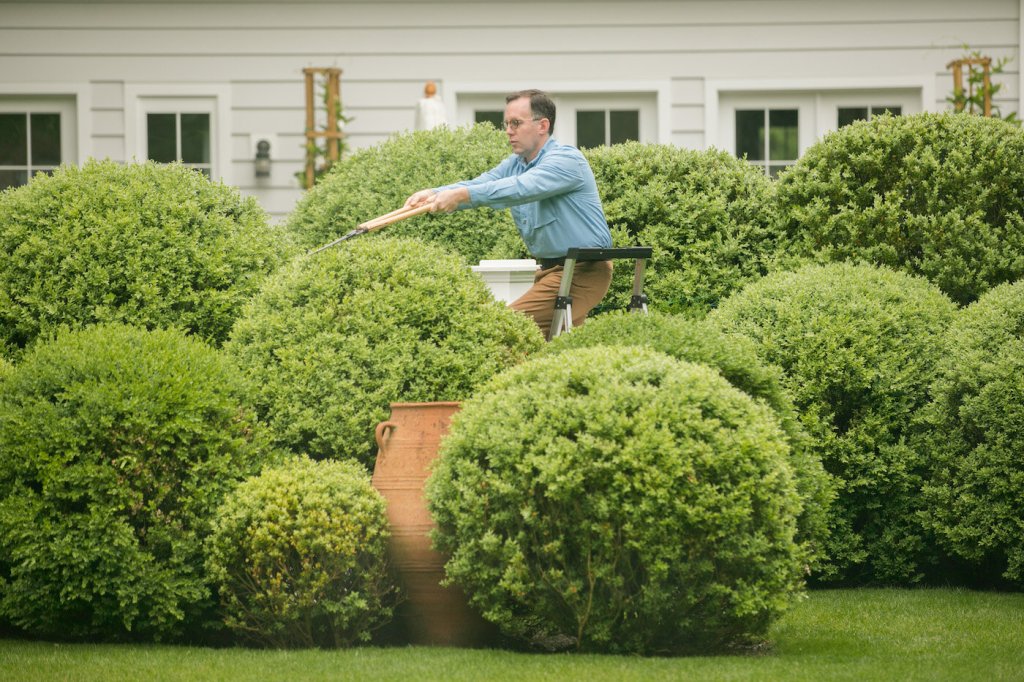
Charles King Sadler is pruning a cloud garden. Notice that the boxwoods have areas for air to pass through without compromising the shape of the shrubs.

Perennials

Continue to deadhead spent perennials that need to keep them looking tidy. Many perennials will rebloom if you do this. If you have flowering plants such as echinacea, rudbeckia, cardoon, and helianthus, consider letting the blooms in late July go to seed to bring seed loving birds to your fall garden.

Keep pinching back those chrysanthemums. Just for a few more weeks.

Shrubs

Continue to prune away the random fly-away branches. You may prune to maintain size, but don’t go crazy. Shearing this time of year can introduce fungal spores, make heat stress worse, and leave unsightly burned edges on leaves.

This is the last month for pruning azaleas before you risk cutting off flower buds for next year. Same for camellia sasanquas. This is also the last month for fertilizing both of these shrubs.

Tipping spent crepe myrtles will encourage new flowers.

Check gardenias for whitefly and black spot. That is real advice and not a recommendation for a new band name.

If you are into propagation, now is the time many shrubs are forming semihardwood, making them easier to propagate.

Roses

Continue to prune for size and dead head.

If roses are blooming (or trying to bloom) continue to fertilize every 10-14 days.

Check for blackspot and rosette disease.

Stop and smell the roses.

Trees

Not much here except to water and prune when needed. Plants that have been in the ground less than 3 years are still susceptible to hot dry weather. Give a little extra mulch if it is looking thin.

Veggies and Herbs

Harvesting should be pretty regular now. Do not let veggies get too big or they will become tough. This is especially true for summer squashes, okra, and eggplant. It feels counterintuitive, but harvesting your herbs more will make them more productive.

Plant mint only in a pot. Always. if you don’t listen to anything I say, listen to this one (I reserve the right to reuse this line on something else).

Potatoes and garlic should be close to being ready, if they aren’t already. Harvest and cure soon.

Fertilize every two weeks. Even if you used compost and great soil.

With the wet humid weather, be on the look out for tomato blight (remove affected growth, mulch so spores don’t get into the soil, and treat with product labeled for blight treatment) , blossom end rot (add calcium), and powdery mildew (copper or sulfur fungicide). Also watch for tomato horn worms. They look pretty threatening but are fairly defenseless. If you have chickens or a friend with chickens, feel free to give the worms to them as a snack. Yum!

Make sure to keep a journal entry with where things are planted this summer so you can practice crop rotation this fall and next summer.

Lawns

You can still plug bermuda if you have patchy areas. All other lawns you will want to wait for cooler weather.

Raise your mower to 2” if you have valuable turf lawn (I just have clover so it doesn’t care if I mow it to nubbins).

The Takeaway

Keep a watch for heat and drought stress. Water deep and mulch thin areas.

Don’t forget to fertilize plants that are actively growing and producing.

Prune for size and to maintain shape, but do not shear this time of year.

Harvest everything that needs harvesting. If you aren’t going to eat them, give them away.

Enjoy the slower pace and the fruits of your labor. Connect with your garden. Every time you connect with your garden you are connecting to nature and to a piece of yourself.

Plant of the Month: Cornus angustata syn elliptica

When I was a kid, I was as close as it gets to being obsessed with Disney’s Sleeping Beauty for two reasons; Maleficent and Eyvind Earle.

Maleficent was my favorite villain in the smaller pantheon of Disney movie characters back then. I think mostly because she was who she was without apology and without the slapstick of the likes of Hook or the ugly step-sisters. I also think I was drawn to her lack of backstory (before the release of Maleficent…which I also enjoyed despite the removal of the mystique). She didn’t want to be the prettiest. She didn’t want to secure her place in society. She was just bad cuz she was bad. My little self also grew to really love the dryness of her sense of humor. For a character with no clear motivations, she was pretty fascinating.

Bwahahahaha

And Eyvind Earle? Who was he in the movie? He actually isn’t a character. He’s the illustrator who gave the artistic vision and style to the movie. And what a style!

I want to live here, please.

Earle’s images are so full of lush, whimsical, moody atmosphere. Growing up in the thick, moss soaked trees of Florida, I could understand the love song Earle composed to forests. Not to sound crunchy, but everyone should dance/play/read/snuggle under a live oak at least once in their life. The way those trees create defined spaces within a forest is nothing short of magic.

I wanted to live in that forest. I still do. It was eternally spring there. His use of simple shapes to contrast different trees and flowers was right up there with the likes of Charley Harper!

I think Cornus angustata syn elliptica would fit into Eyvind’s imagined world quite easy, even if it is mouthful to say.

In fairness, you don’t have to say the entire name. I’m just being thorough. Cornus angustata is also called Cornus elliptica. Most people in the trade only call it one name: ‘Empress of China’ Dogwood.

Though there could be confusion about the name (I’m only mentioning the 2 most common classifications. This tree has been shuffled around from species to species, to subspecies and back so many times), there’s no confusion about the beauty of this tree.

Dogwoods are funny things. Here in the south, they are about as ubiquitous as our Southern Magnolia and as equally celebrate. Our native dogwood, Cornus florida blooms in the early spring before the foliage emerges (most years). Its “petals” are large, undulating, and papery on the tips of fine delicate branches. In fall, the trees wide papery foliage changes to hues of crimson, red, and orange. In early winter the fertilized flowers bare bright red berries that attract birds. The entire tree can get up to 30’ tall, but we most often see them age out at about 20’ish with a wide, umbrella like shape. They are happiest in filtered light but can adapt fine to full sun if given enough water.

Another popular dogwood is the Korean dogwood, Cornus kusa. This smaller tree has stiffer leaves and a more compact habit. Reaching about 20’ tall and 15’ wide, the kusa dogwood forgoes the early spring show for a later presentation. Kusas bloom late spring with a profusion of small white “flowers” that sit atop the foliage. These flowers fade after 3 weeks and bare small strawberry looking fruit in the fall. After the foliage turns red and drops, the little fruit hang like wee ornaments until the birds abscond with them.

There are of course many other cornus species that I could discuss, from the cornelian cherry to the flame twig varieties. But those discussions will have to happen at another time. For we are here to sing the praises of the Empress of China Dogwood.

We recently had a small group of friends over for Memorial day. The garden looked pretty darn good. The crew and I had been in it early spring and as such, most of my plants look happy and well cared for. That hard work did not go unnoticed as our friends asked me about various beauties they had not seen before. But one plant got more questions and comments than any other.

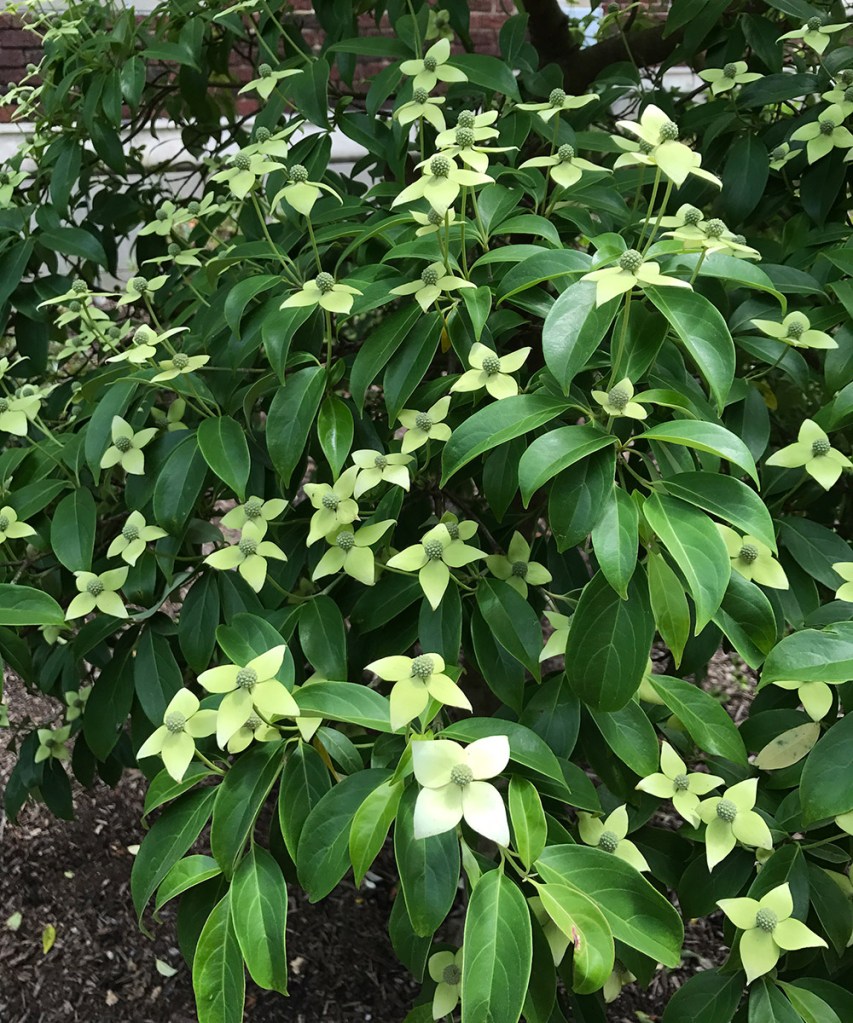
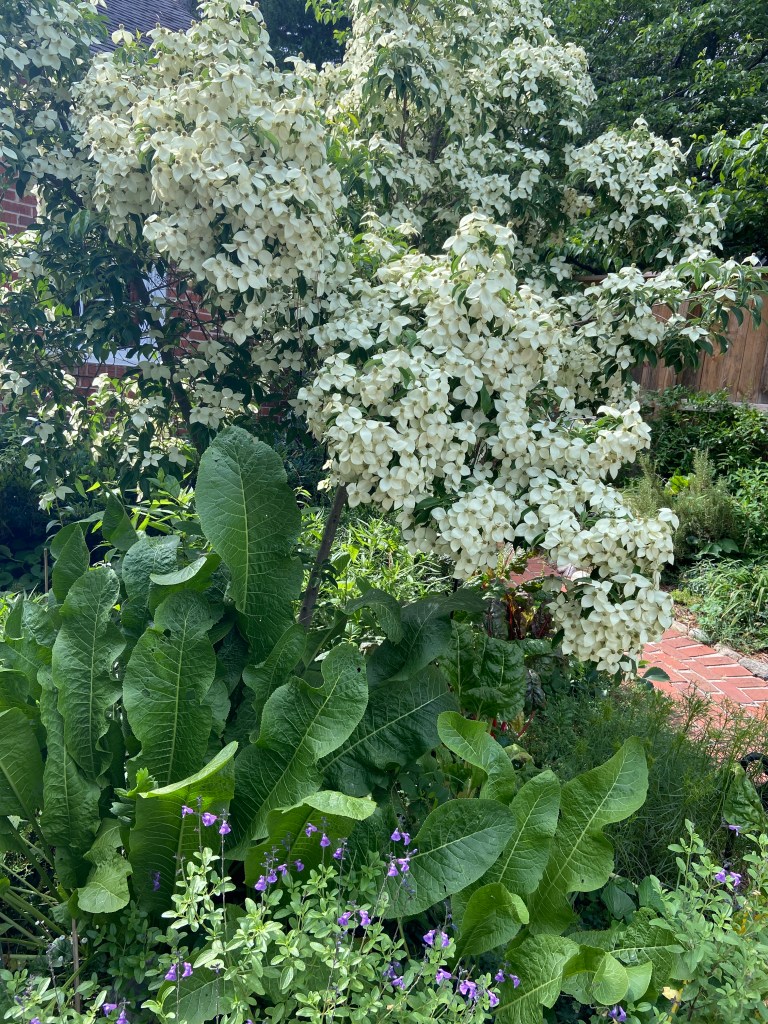
The same dogwood as the first in this post 4 weeks later.

My Empress of China dogwood traveled to this home with me in a large clay pot. I had ordered it years ago from some specialty nursery and kept upsizing the pot as she grew from a wee 4” plant to about 3 feet. When we moved to our home in Ormewood Park Atlanta, I gave her what I thought would be her permanent home. A few years later, my hubs pointed at her and said ”I want that tree moved over here. I want to see more of it.” He rarely makes demands of the garden, so when he does, I oblige.

Moving her wasn’t an easy task. In native soil she had grown fast and her root system was extensive. But we managed and with a little bit of pampering she made it through.

The Virtues!

So much exposition. Get to the meat, Joshua!

Like all dogwoods, Empress of China has showy bracts. The flowers are insignificant but do attract hoards of native bees and pollinators. The real attraction for us non winged humans are the bracts (now you know why I kept putting the words petals and flowers in quotations). The first flopwer shapes start about early April. The bracts continue to grow over the course of, not days or even weeks, but months. This tree has had flowers on it for months.

Eventually, by late June, the bracts will fall like snow from a branch, creating a sweet white blanket on the ground for several days before the summer heat dries them to mulch. The fertilized flowers will begin to grow and ripen to create a fruit much like the kusa dogwood, only slightly translucent.

Fruit are edible, but not particularly tasty. Slightly tart and mealy. I’d leave them for wildlife, but if you have an interesting recipe I’m interested to hear.

In the fall the leaves turn crimson and purple along the margin and then…

Well, and then they just stay there. Depending on what kind of summer and winter we have, these trees are either evergreen or semievergreen. If the summer is significantly wet and the winter mild the leaves persist into spring when new growth pushes the old growth off. If we have a dry summer and cold winter, the tree loses about 70% of the leaves, but keeps enough to provide some screening.

Empress of China gets about 20’ tall and 15’ wide. Mine is about 10’ at 10 years (but remember it was in a pot for several years and then got moved 4 years ago).

Though they prefer filtered sun, they can handle full sun with a little more water. I did give mine a camel bag this year when we went 6 weeks with no rain. But in fairness, nothing really loves going that long without water that isn’t a succulent.

I believe Empress of China does a wonderful job of extending spring into the summer. The profusion of flowers and evergreen foliage reminds me that some cycles are longer than the seasons we are so used to. They remind me that some things persist even when we expect them to be fleeting.