
It’s shortly after Mother’s Day, 2022 and you can blame that on this entry.
Mother’s Day wasn’t a HUGE holiday in my family. Mom was a LDRP RN (I’m sure I’m missing some letters in there) and worked Sunday-Thursday starting at 7pm. So much of Mother’s Day she was asleep and when she was awake, she was getting ready for work. It was a weird schedule, but she loved what she did. She was one of 2 nurses in SC that specialized in high risk pregnancies and her expertise was well known in the state and region.
Despite the holiday not being a big deal, I often made sure that there was something sitting on the counter for her when she came downstairs before work. Sometimes they were just cards and some trinket. But I often went with what I knew and that was a plant from the local nursery.
My parents joked that I have two green thumbs, and neither one of them contributed that to me. And in truth, every time I gave her an iris, calla lily, stargazer, or rose, we all knew it was doomed. But those were her favorites and I always carried a spark of hope that THIS would be the plant that made it. Almost none of them made it, in fact. But one did.
A peony. Peonia lactiflora ‘Festiva Maxima’ to be exact.

It is well known among peony people that the south…well it isn’t for peony people. Our humidity and persistent heat do not match well with peony’s more delicate and temperate disposition. They love a warm day in bright clear sun, then they want to be cool at night so they can turn all that energy into starchy sugars to fuel their bright colored petals. When planted here, you may get 2 or 3 years before the plant just starts to send out a leaf or two. It will do that for a few more years and then they will diminish and go into the west and remain Galadriel.
But two peonies appear to laugh in the face of never ending heat and warm nights; ’Festiva Maxima’ and ’Sarah Bernhardt.’
‘Festiva Maxima’ is a stand out peony. It’s mostly pure white petals are peppered with magenta stripes that look almost painterly. It’s traditional peony fragrance is unmistakable, and I defy you to not think of some matronly figure in your past when you smell it. Most years my ‘Festiva Maxima’ has flowers the size of a salad plate (I felt snobby just writing that). Some years, when I’ve been neglectful and my peony wants to punish me, the flowers are the size of a large softball (Ha! Take that, middle school bullies. I know sports).
‘Sarah Bernhardt’ is a deep blush pink peony. The flowers I see in my client’s gardens are a little smaller than ‘Festiva Maxima’ but there do seem to be more of them. Fragrance is just as lovely as ‘Festiva Maxima’ but not quite as heady. The flowers tend to hold themselves up a little better. But I feel strongly both should be given some support; either peony cages or gladioli stakes (yes, I just lost all the earlier sport cred with that last statement).
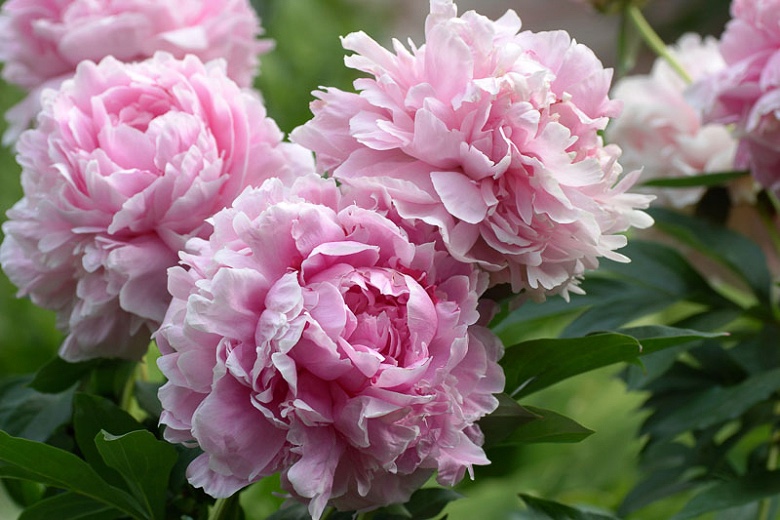
Both varieties are considered early blooming, and that may be one of the reasons they do well here; they bloom before the exceptional summer heat starts. You can also help your peonies get the cold they need to set bud by being really stingy with your mulch in the winter, but generous in the summer. Planting shallow can help expose the roots to more cold.
On the topic of cold (and hot), place your peony where it gets good morning sun and afternoon shade. Since westerly sun is a good bit hotter than eastern, giving them protection will further efforts to keep them cool. I have heard tale of people also setting bags of ice on their peonies a few times a week in February to simulate that late winter chill that peonies love. I have not tried this myself, but it isn’t as kooky an idea as it sounds. The Augusta Golf Course does this same thing to prevent azaleas from blooming too early in the spring.
Because so much energy goes into creating these luscious blooms, apply a slow release fertilizer with a higher potassium (third number in the NPK ratio) in early spring, and a fertilizer with a higher phosphorus (the second number in the NPK ratio) after the plants finish blooming. Potassium helps boost flower production. Phosphorus helps build strong roots in flowering plants, which in turn gives stronger blooms and healthier foliage.
once the blooms fade, the plant sports attractive large coarse textured leaves that pair well will a lot of other sun loving perennials and shrubs. Prune the foliage off the plant when the foliage starts to look tired. I generally remove a leaf when over 50% looks brown and yellow. You should set peony foliage into a waste bag, as peony leaves do often carry and encourage botrytis fungus.
If you are considering peonies in your southern garden, I strongly encourage you to look into these two varieties. They are great performers and worth giving them a little space in your garden.
I’ll dedicate this entry to my mom, Pamela Sue (Miss Pammy, as she liked to be called). I hope everyone reading has had a mother figure in your life that allowed you to feel safe and loved. Mom, I love and miss you and hope you are surrounded by all the plants you killed, mostly from loving them to death.


 Alchemy Gardens and Design