
When we first purchased our Ormewood Park home, I would describe the landscape as…lacking. The previous owners had stripped everything they deemed valuable to transplant in their new home just a few houses up from us, leaving only a few trees and shrubs that were most likely too large to economically move. We inherited a few holly shrubs, a large upright Japanese Maple, a curly willow, Hollywood Juniper, and some deciduous magnolias. Also a collapsed pool that had seen more activity from frogs and mosquitos than human swimmers in the past few years.

Around this time, not only did our new home have new residents, but Georgia did as well. At some point, a hitchhiker from another country found a welcoming home in the red Georgia clay. Maybe it was brought on purpose. Maybe someone found a stray seed clinging to their clothes and tossed it out of the window. Perhaps someone ordered a bag of seed to use as a grain substitute in an effort to reduce their carbs, dropped some on the floor and casually swept it outside. We don’t know how it got here, but Achyranthes japonica wants to make your garden its permanent home. I advise not allowing that to happen.
Achyranthes japonica, or Japanese Chaffe flower showed up the year after we purchased our home. I remember seeing it and being curious as to what it could be. Indeed, it had a very pleasant, I’m-meant-to-be-here look to it, with entire smooth edged and opposite leaves. I let them grow and as they got taller kept trying to figure out what it was.
I confess, it wasn’t until after it had seeded that I came to realize it wasn’t wanted, even before I knew what it was.
Chaffe flower LOOKS like something you want in your garden. It has all the hallmarks of something you may have purchased in a garden center. The leaves start off rather dark green, with strong venation and a pleasing undulation. It maintains a somewhat compact growth habit for a while before it reveals itself to be a weed with rangy and sprawling growth.

A member of the Amaranth family, Japanese Chaffe Flower is named for the small seed heads that cling to clothes, fur, leg hair, and pretty m,ugh anything it can grab onto. After passing by a seeding plant in my super comfy loose fit sweats (I was wearing the sweats, not the seeding plant), it was a matter of just a few steps before the seeds that had grabbed hold of my pants began to grab the fabric as it moved, adhering the folds together until my pant legs were just a matted clump of fabric clinging to my leg.
When the seeds first germinate (seeds are extremely viable, meaning most seeds will germinate), the leaves are slightly oval with a rounded point. The margins are entire, meaning smooth with no cremate, serrate, or dentate edging. To me they almost always look like they are struggling, like a bug or fungus is affected them. They look very similar to other amaranth seedlings like celosia or spinach. Indeed, this plant is edible and medicinal. But I don’t believe these virtues make up for the invasive tenacity this plant possesses. It can push through the thickest of ground covers and will out compete some of the toughest perennials and small shrubs.

Unlike many Amaranth, the leaves remain opposite.

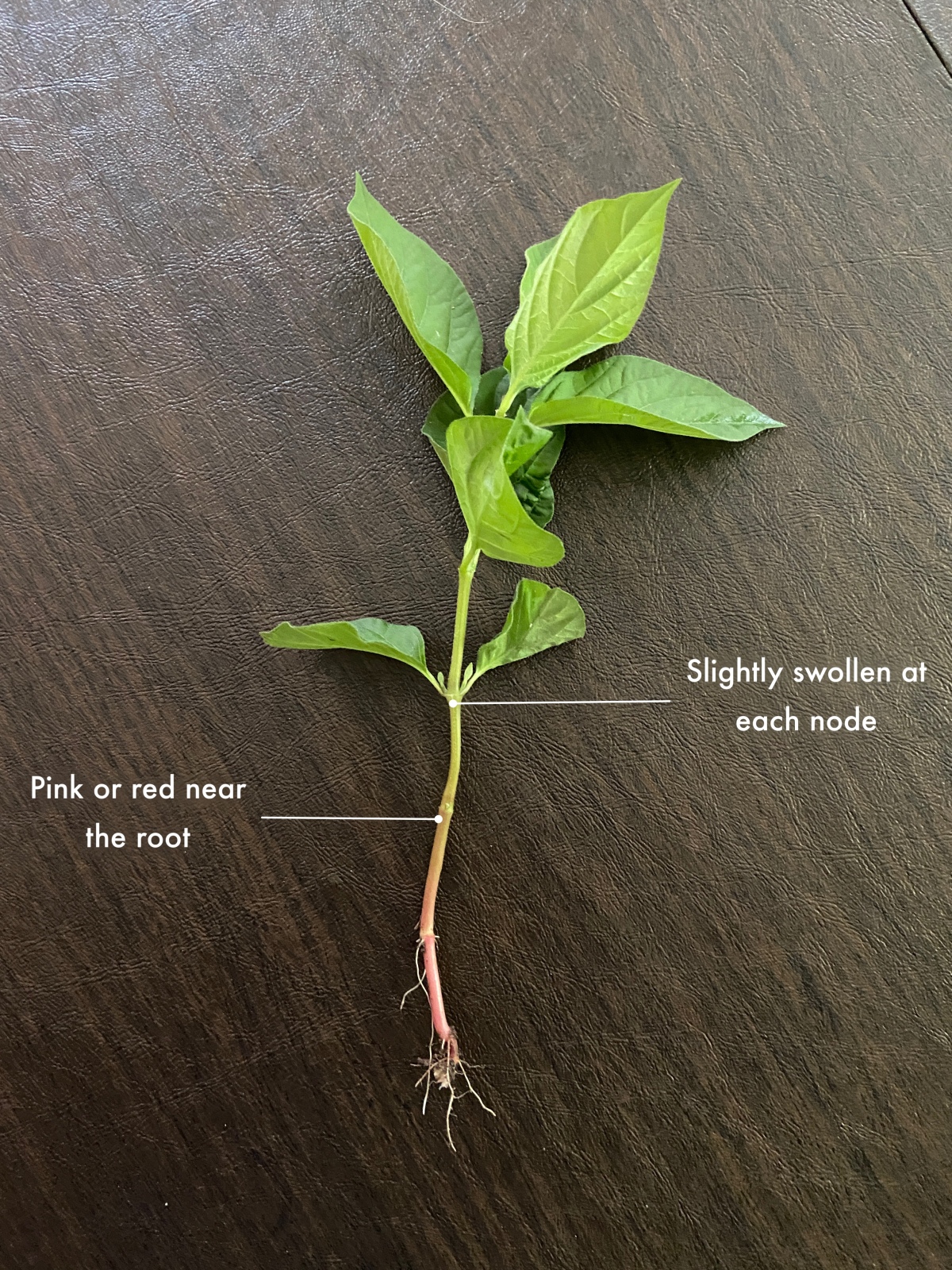
The stem near the top of the plant has a square feeling, accentuated by small ribs running up the length of the stem. At each node, where the leaves join the stem, the stem is slightly swollen. The stem gradually becomes a pinkish color near the base.
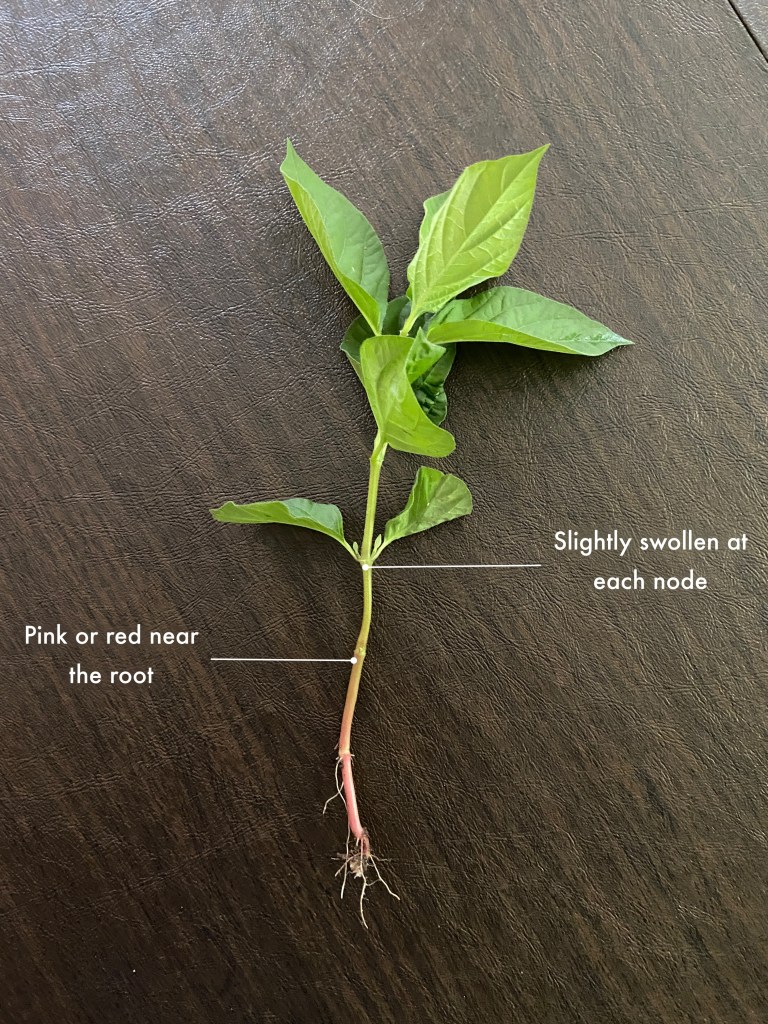
Roots are often fleshy and thick. This specimen shows more root hairs as the thicker stems refused to come up, breaking at one of the submerged nodes. I suggest using a hand trowel or knife to assist in getting the roots.
Then destroy it with fire. Ok, that’s hyperbolic. But definitely do not compost this weed, or it will mock you. Bag it securely and pray it never finds its way back to you. That isn’t hyperbolic.


 Alchemy Gardens and Design